
Key takeaways
- SOL trades near $73, roughly 75% below its January 2025 high of $294, and tracked Binance whale positioning leans bearish (about 20% longs) while around 79% of broader accounts are long.
- PumpGlass shows a $19.5 million short-liquidation cluster near $79.01 and long-liquidation clusters near $69.39 and $68.01.
- Bitwise’s $385 base case depends on tokenized-stock trading, and a $2,000 SOL would imply about $1.38 trillion in total-supply value under NewsBTC’s 690 million-token assumption.
- NewsBTC’s conditional 2030 scenarios are bearish $40–$110, base $180–$400, bullish $600–$1,000 and extreme upside $1,500–$2,000+.
Solana has lost roughly 75% of its value since reaching an all-time high of $294 in January 2025. Large futures traders are leaning bearish, yet institutional analysts continue to see a future in which SOL trades at four digit prices. So, how realistic is a $2,000 Solana price prediction for 2030?
At around $73, SOL is trading at a fraction of the price some of Wall Street’s most optimistic forecasts suggest it could eventually reach. But a steep discount to an analyst’s target does not necessarily make an asset cheap.
NewsBTC examined liquidation heatmaps, whale positions, historical price action, network economics and institutional valuation models to understand where Solana stands today and what it could realistically be worth by the end of the decade.
The findings paint a more complicated picture than either bulls or bears might expect.
Solana Whales Are Betting Against the Crowd
Perhaps the most interesting signal right now comes from the derivatives market.
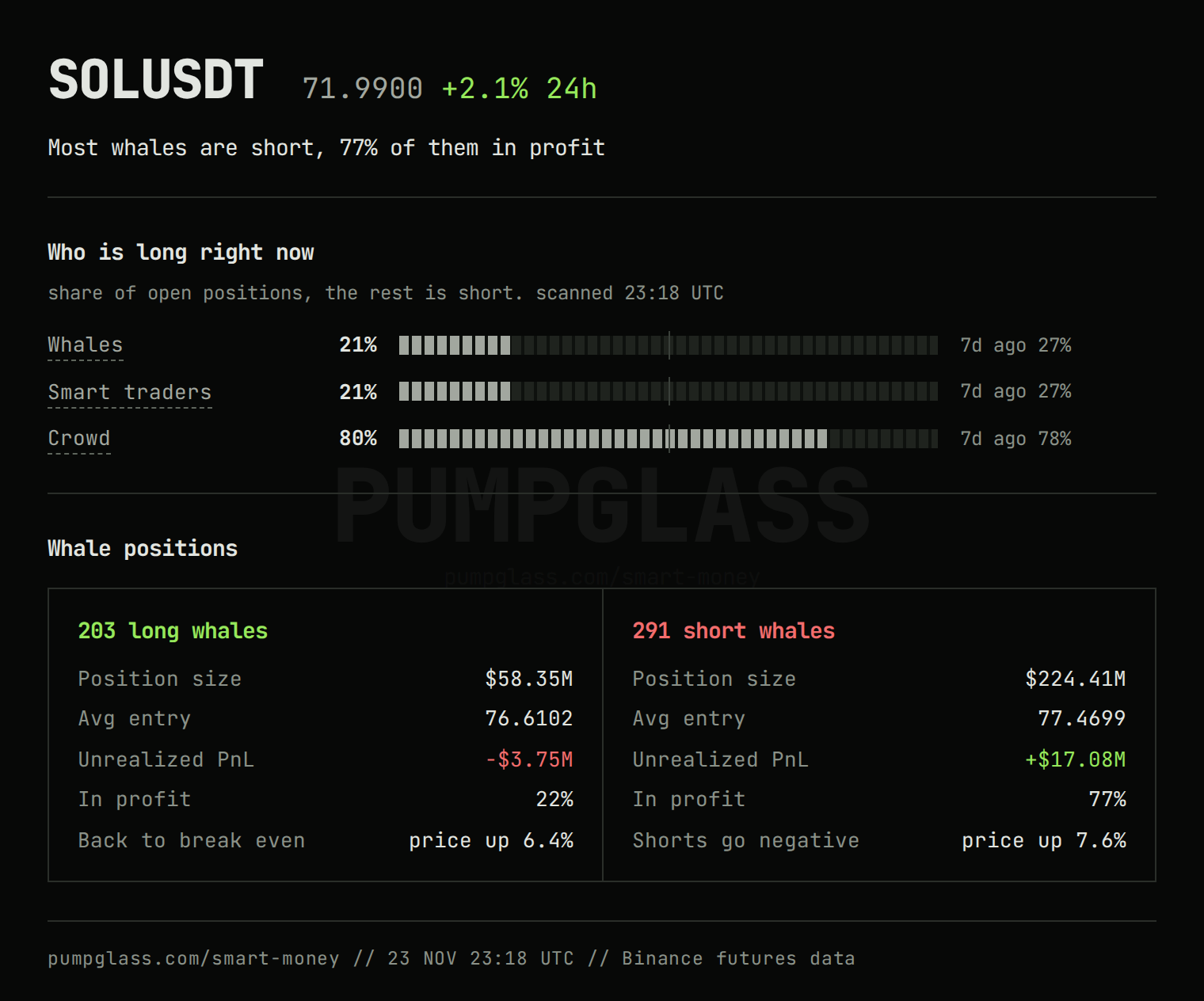
According to a November 23 snapshot from PumpGlass, only around 20% of the tracked Binance whale position value was allocated to longs. Meanwhile, approximately 79% of the broader trader accounts were positioned long.
Although the two figures measure different aspects of market positioning, the divergence is striking. Large traders appear considerably less optimistic than the wider trading crowd.
The average entry price of tracked whale shorts stood near $77.63, compared with $77.05 for whale longs. With SOL trading around $73 at the time of observation, the short side was better positioned.
The on-chain picture offers another reason for caution.
On November 19, blockchain tracker Lookonchain reported that two large holders had unstaked a combined 2.31 million SOL worth approximately $169.4 million before transferring the tokens to Coinbase Prime-associated addresses.
Exchange deposits do not necessarily mean those tokens were sold. Institutional investors use custody platforms for several purposes, including collateral management and portfolio rebalancing. Still, the movement is worth monitoring.
What matters now is whether large holders begin accumulating again or whether the recent decline has further to run.
A $19.5 Million Liquidation Cluster Could Influence SOL’s Next Move
Solana’s liquidation heatmap reveals an interesting battle developing around its current trading range.
PumpGlass identified several concentrations of potentially vulnerable leveraged positions in its November 23, 19:22 UTC observation.
| Price level | Estimated liquidation exposure |
|---|---|
| $79.01 | $19.5 million in shorts |
| $69.39 | $10.7 million in longs |
| $68.01 | $15.1 million in longs |
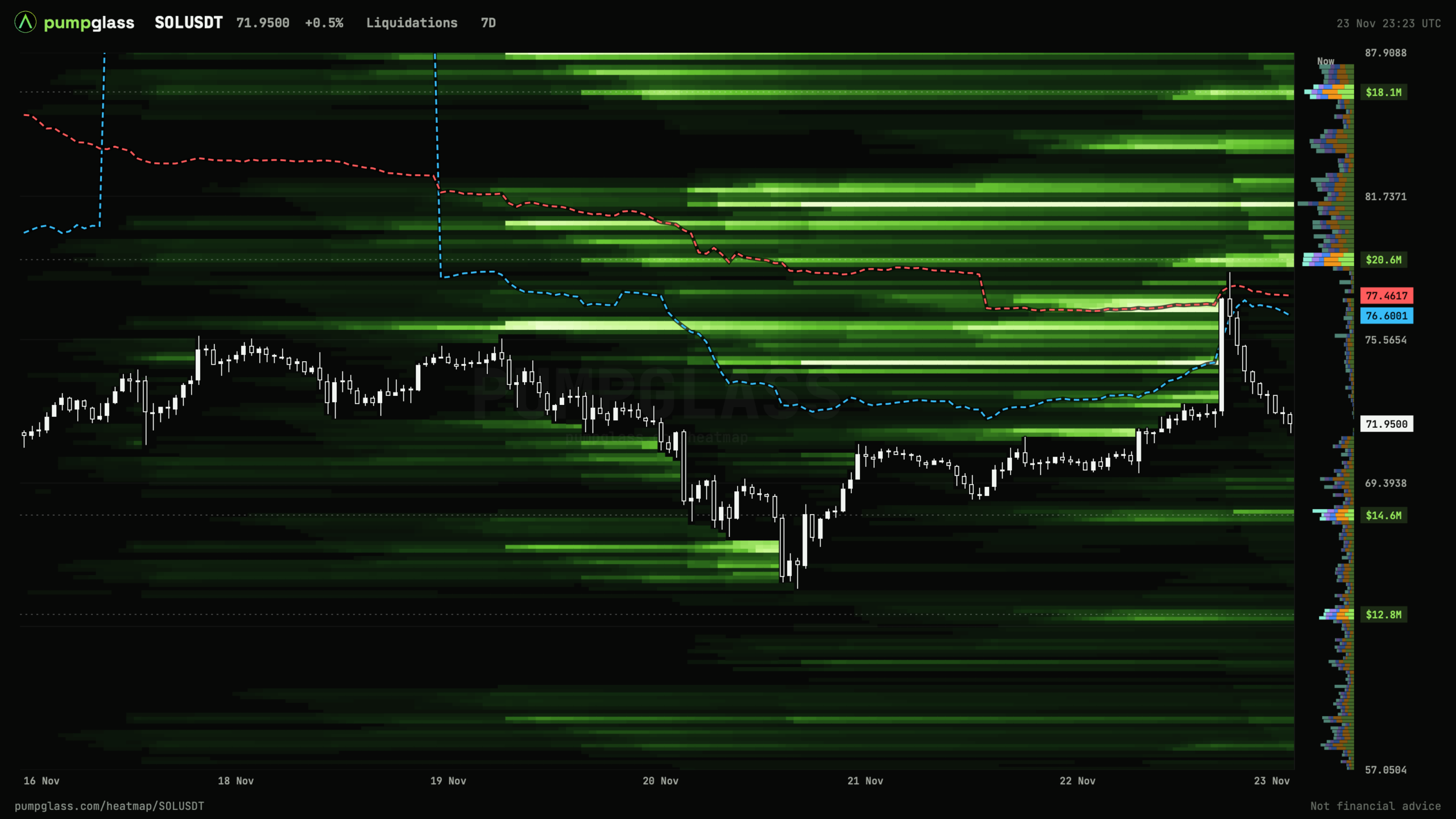
A recovery toward $79 could put considerable pressure on short sellers. Conversely, a breakdown below $69 could expose another wave of leveraged longs to forced closures.
Data from CoinGlass adds another layer to the picture. At 21:31 UTC on November 23, Solana’s futures open interest stood at $3.86 billion, while rolling 24-hour liquidations reached approximately $30.59 million. Shorts accounted for roughly 72% of those liquidations.
SOL had gained around 3.1% over the same rolling period.
The recovery is consistent with some bearish positions being forced out of the market. However, a liquidated short is not the same as a new investor buying SOL for the next four years.
Until stronger spot demand emerges, traders should be careful about interpreting a short squeeze as the beginning of a sustainable recovery.
Liquidation concentrations are modeled estimates, not guaranteed future orders, and can change considerably as traders adjust their positions.
Solana Technical Analysis: The Levels That Could Change Everything
Solana’s price structure has deteriorated considerably since its September recovery.
After closing July near $72.79, SOL climbed to $103 in August and $117.99 in September. The recovery subsequently unraveled, with October closing near $95.35 before prices returned to the low $70s in November.
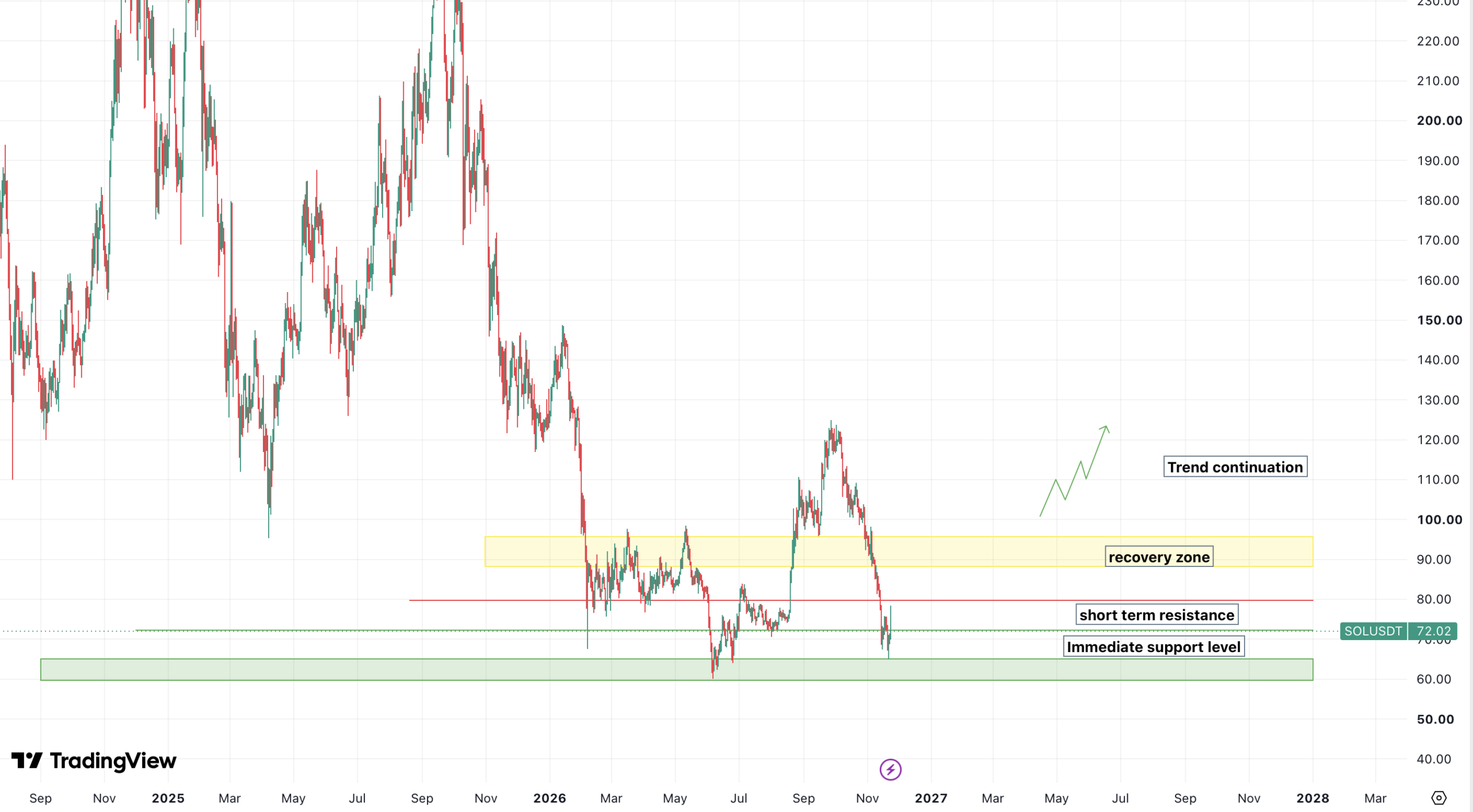
Looking at SOL’s historical price action on Binance, using the TradingView SOLUSDT market as the chart reference, five key price regions stand out:
| SOL price | Technical significance |
|---|---|
| $60–$65 | Major downside reference |
| $69–$71 | Immediate support |
| $75–$80 | short term resistance |
| $88–$95 | Intermediate recovery zone |
| $100–$118 | Broader trend recovery territory |
The daily Relative Strength Index was in the low 30s in the observed CoinGlass data, suggesting weak momentum and proximity to oversold territory.
But oversold markets can remain oversold.
A sustained recovery above $80 would be the first encouraging development. Reclaiming $95 and subsequently $100 would provide stronger evidence that buyers are regaining control.
On the downside, failure to hold the $65 range would bring Solana’s 2026 low near $60.42 back into focus.
Our technical assessment remains cautious. There is room for a meaningful relief rally, particularly given the nearby short-liquidation exposure, but the broader market structure has yet to establish a convincing reversal.
The $73 Token Behind a Multibillion-Dollar Economy
While Solana’s price has struggled, its blockchain continues to facilitate substantial financial activity.
According to DefiLlama, Solana’s November 23 network metrics included:
| Network metric | Reported value |
|---|---|
| DeFi total value locked | $4.68 billion |
| Stablecoin market capitalization | $13.14 billion |
| Daily DEX trading volume | $1.12 billion |
| Daily active addresses | 1.8 million |
| Daily transactions | 83.42 million |
| Daily application revenue | $2.07 million |
| Daily chain revenue | $23,978 |
There is something particularly interesting about those last two figures.
Applications running on Solana generated considerably more revenue than the chain itself under DefiLlama’s respective measurement definitions.
This highlights what could become Solana’s biggest valuation challenge.
A blockchain can attract substantial activity and billions of dollars in trading volume without its native token capturing a proportional share of that economic value.
Cheap transactions are excellent for adoption. Whether they are equally good for SOL’s valuation is another question entirely.
That is why Solana’s expansion beyond speculative trading could prove so important.
The blockchain’s growing presence in stablecoins, payments and tokenized real-world assets opens the door to financial activity that could persist even when speculative markets cool.
Its infrastructure is also evolving. The Solana Foundation reported the activation of Alpenglow in October 2026, targeting transaction finality near 150 milliseconds. November’s introduction of Solana 1.0 marked another milestone in the network’s development.
Meanwhile, the announced integration with DTCC’s Tokenization Service, expected in the second half of 2027, could represent a meaningful institutional opportunity.
The real test will be how much financial activity these developments ultimately bring onchain, and how much value SOL captures from it.
Wall Street’s Solana Price Predictions Are Surprisingly Far Apart
Institutional research offers a glimpse into how differently analysts view Solana’s future.
| Research firm | Bear case | Base case | Bull case / reported target | Horizon |
|---|---|---|---|---|
| VanEck | $9.81 | $334.70 | $3,211.28 | 2030 |
| Standard Chartered | Not disclosed | Not disclosed | $2,000 target | 2030 |
| Bitwise | $80 | $385 | $1,100 | 2031 |
VanEck’s October 2023 research produced one of the widest forecast ranges, with its most optimistic scenario placing SOL above $3,200.
Standard Chartered’s Geoffrey Kendrick was reported in February 2026 to have projected a $2,000 Solana price by 2030, partly based on the network’s potential in stablecoin micropayments.
However, the bank’s reported $250 end-of-2026 target looks increasingly difficult to achieve from current levels. Its original research note was not available for independent review.
Perhaps the most interesting analysis comes from Bitwise’s November 2026 research, which connects Solana’s future valuation to tokenized stock trading.
The asset manager’s base case assumes Solana captures 50% of tokenized-stock trading volume in 2031, generating approximately $6.75 billion in annual network economic value.
Applying a 40-times valuation multiple produces an estimated SOL price of $385, based on a projected total supply of 700 million tokens.
The report acknowledges the key dependency:
“Most of the price increase depends on how quickly stocks move onchain.
Bitwise · November 2026 research
In its bullish scenario, Solana captures 65% of tokenized-stock trading, generating approximately $12.83 billion in network economic value and supporting a modeled price of $1,100.
These assumptions reveal just how much needs to go right before four-digit SOL prices become fundamentally convincing.
The $1.38 Trillion Problem With a $2,000 Solana
Here is something many price predictions overlook: Solana’s token supply will not necessarily remain where it is today.
Unlike Bitcoin, SOL has no fixed maximum supply. Its inflationary issuance framework rewards validators and staking participants, while future governance decisions can influence the rate of supply growth.
With around 592 million SOL currently circulating, we use an illustrative assumption of 690 million total tokens by 2030 for our valuation scenarios.
The numbers put popular price targets into perspective.
| SOL price in 2030 | Implied total-supply valuation |
|---|---|
| $100 | $69 billion |
| $300 | $207 billion |
| $500 | $345 billion |
| $1,000 | $690 billion |
| $1,500 | $1.035 trillion |
| $2,000 | $1.38 trillion |
| $3,000 | $2.07 trillion |
These are total-supply valuations rather than projected circulating market capitalizations.
At $2,000, Solana would need to command a valuation of approximately $1.38 trillion under our assumptions.
Using Bitwise’s base-case valuation multiple of 40 times annual network economic value as an illustrative benchmark, Solana would need to generate approximately $34.5 billion in annual economic value to support that figure.
Even at a more generous 60-times multiple, the requirement would be $23 billion annually.
That is substantially more demanding than simply attracting another wave of cryptocurrency traders.
Our Solana Price Prediction for 2030
Based on the network’s economic opportunity, competitive landscape, token supply and institutional research, NewsBTC has developed four conditional valuation scenarios.
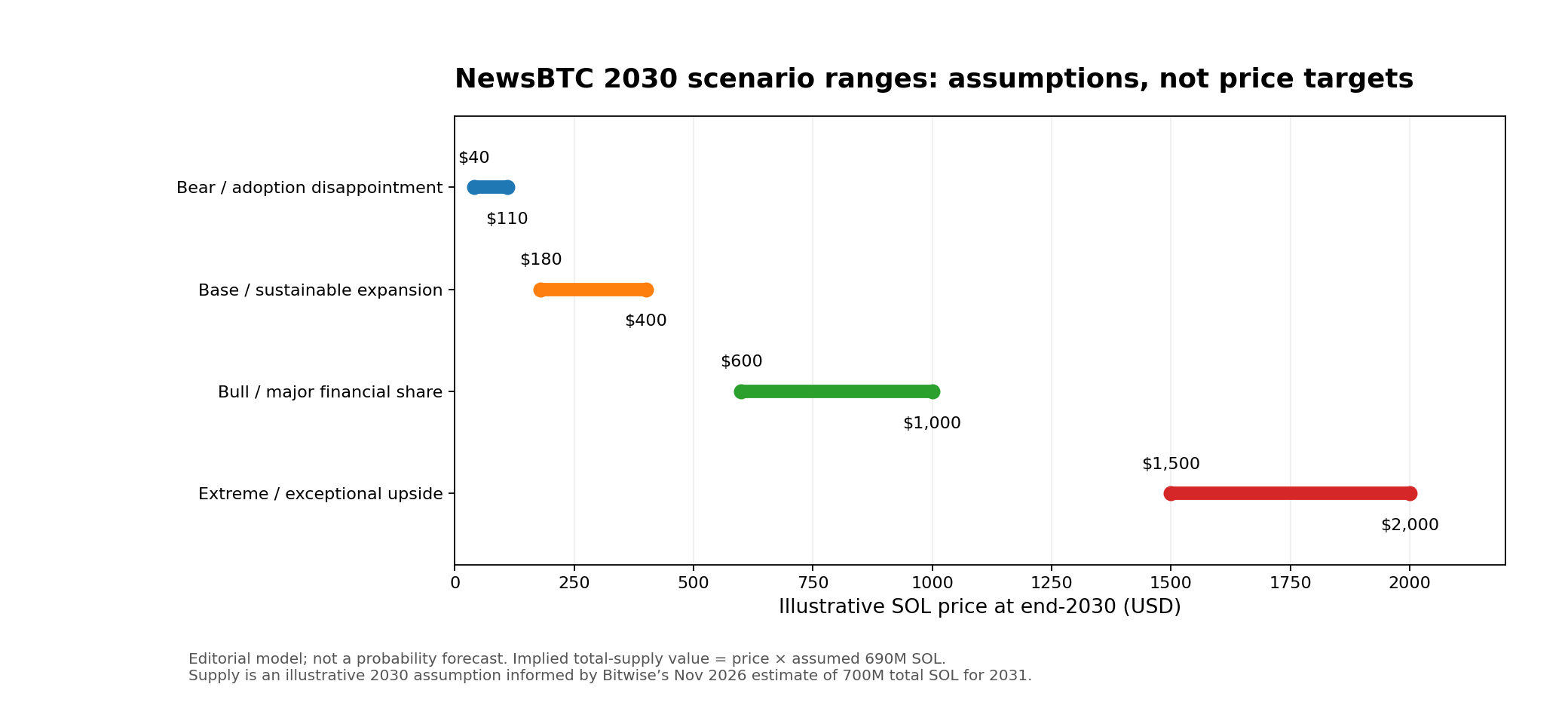
| Scenario | SOL price in 2030 | Implied total-supply value |
|---|---|---|
| Bearish | $40–$110 | $28B–$76B |
| Base case | $180–$400 | $124B–$276B |
| Bullish | $600–$1,000 | $414B–$690B |
| Extreme upside | $1,500–$2,000+ | $1.04T–$1.38T+ |
These ranges are conditional editorial scenarios, not statistically derived forecasts. Outcomes outside these ranges, including substantially greater losses, are possible.
Bearish Scenario: $40–$110Solana remains relevant but struggles to turn network adoption into meaningful economic value for SOL. Institutional projects develop more slowly than expected, competitors gain market share, and speculative trading remains an important source of demand.
Solana does not need to fail for this scenario to materialize. It only needs to fall short of the expectations investors have placed on it.
Base Scenario: $180–$400Our central expectation assumes Solana retains its position among the leading smart-contract networks while expanding its role in payments, DeFi and tokenized financial assets.
Under this scenario, the network does not need to dominate global finance. It needs to establish a durable position within it and capture more economic value from the applications it supports.
Bullish Scenario: $600–$1,000Solana becomes a major platform for tokenized equities, stablecoin settlements and high-frequency financial applications.
Institutional adoption moves beyond announcements, network revenue expands significantly, and the broader cryptocurrency market benefits from favorable liquidity conditions.
At $1,000, SOL would trade at approximately 13.8 times its November 23 reference price.
Extreme Scenario: $1,500–$2,000+This is where the most ambitious institutional predictions become conceivable.
Solana would need to capture a significant share of a much larger on-chain financial economy, scale its infrastructure accordingly, and translate that activity into sustained demand for SOL.
An exceptional cryptocurrency bull market could also temporarily push valuations beyond what underlying economics justify.
We would not consider this the most likely outcome based on today’s evidence.
The Five Signals That Could Make Us Raise Our Forecast
Rather than following every new price target, long-term SOL investors may benefit from monitoring five developments:
- Stablecoin adoption: Growth in recurring payment and settlement activity beyond speculative trading.
- Institutional tokenization: Actual financial instruments and trading volumes going live on Solana.
- Network economics: Sustained growth in fees, economic value and demand for SOL.
- Institutional capital: Persistent ETF inflows and broader spot-market participation.
- Technical resilience: Reliable performance under heavy demand without sacrificing security or decentralization.
Competition from Ethereum, its scaling ecosystem and specialized financial networks remains a considerable risk.
If Solana’s transaction volumes rise while the economic value captured by the network stagnates, we would have reason to lower our valuation assumptions, regardless of how impressive the adoption statistics look.
Is Solana Undervalued at $73?
The current market offers an interesting contradiction.
Solana’s blockchain has established a meaningful financial ecosystem, yet its token is trading roughly 75% below its historical record. Large futures traders are cautious, while institutional research continues to outline substantial long-term opportunities.
Our $180 to $400 base-case range for 2030 reflects the possibility that Solana can grow without fulfilling every ambitious expectation placed on it.
A move toward $1,000 is conceivable under considerably stronger conditions. At $2,000, however, investors would be betting on Solana becoming one of the world’s most valuable digital financial networks.
The opportunity is there. The evidence that would justify such a valuation is not there yet.
For now, the most interesting question surrounding Solana is not how many transactions it can process, but how much those transactions will eventually be worth to SOL holders.
Solana Price Prediction 2030: Frequently Asked Questions
How much will Solana be worth in 2030?NewsBTC’s analysis places Solana between $180 and $400 by 2030 under our base-case scenario. Strong institutional adoption and improved network economics could support a bullish range of $600 to $1,000, while weaker growth could leave SOL trading between $40 and $110.
Can Solana reach $500 by 2030?Solana could reach $500 by 2030 if its adoption across payments, DeFi and tokenized financial assets continues to expand. Based on an assumed total supply of 690 million SOL, a $500 price would imply a total-supply valuation of approximately $345 billion.
Can Solana reach $1,000 by 2030?A $1,000 Solana price is possible under a strong bullish scenario. However, achieving and sustaining that valuation would require substantial institutional adoption, higher network economic value and favorable cryptocurrency market conditions. At $1,000, Solana’s implied total-supply valuation would reach approximately $690 billion.
Can Solana reach $2,000 by 2030?Standard Chartered was reported to have projected a $2,000 SOL price by 2030 in February 2026. However, our analysis considers this an extreme bullish scenario. Reaching $2,000 would imply a total-supply valuation of approximately $1.38 trillion, requiring extraordinary growth in Solana’s financial ecosystem and demand for SOL.
Can Solana reach $10,000?While mathematically possible, a $10,000 SOL price would imply a valuation of approximately $6.9 trillion based on our 2030 supply assumption. There is currently insufficient economic evidence to support such a valuation within this timeframe.
Is Solana a good investment for the next five years?Solana offers long-term exposure to decentralized finance, stablecoin payments and institutional asset tokenization. However, its investment potential depends on whether growing network adoption translates into sustainable demand for SOL. Competition, token inflation, market volatility and regulatory developments remain significant risks.
Will Solana overtake Ethereum by 2030?Solana could challenge Ethereum in areas such as decentralized trading, payments and financial applications. However, overtaking Ethereum by market capitalization would require substantial growth in Solana’s economic value, institutional demand and developer ecosystem. Higher transaction volumes alone would not guarantee that outcome.
What are analysts predicting for Solana in 2030?VanEck’s October 2023 research placed SOL at $334.70 in its base case and $3,211.28 in its most optimistic scenario for 2030. Standard Chartered was reported to have projected $2,000 in February 2026, while Bitwise’s November 2026 research estimated a base-case price of $385 and a bullish price of $1,100 for 2031.
What could cause Solana’s price to fall further?Weak spot demand, large-holder selling, leveraged liquidations, network disruptions and deteriorating global liquidity could all contribute to further declines. From a technical perspective, losing the $60 to $65 support region identified in our November 23, 2026 analysis would significantly weaken the recovery outlook.
How much could $1,000 invested in Solana be worth in 2030?Using the November 23, 2026 reference price of $72.52, a $1,000 investment would purchase approximately 13.79 SOL.
| SOL price in 2030 | Investment value | Potential return |
|---|---|---|
| $40 | $552 | -44.8% |
| $110 | $1,517 | +51.7% |
| $180 | $2,482 | +148.2% |
| $400 | $5,516 | +451.6% |
| $600 | $8,274 | +727.4% |
| $1,000 | $13,789 | +1,278.9% |
| $2,000 | $27,579 | +2,657.9% |
These hypothetical calculations exclude staking rewards, trading fees and taxes. Actual returns may differ substantially, and investors could lose their entire investment.
Research methodology and data disclosureThis analysis uses CoinGlass and PumpGlass market observations dated November 23, 2026, at 21:31 UTC and 19:22 UTC, respectively. Network metrics are provisional DefiLlama observations dated November 23. Technical analysis uses historical Binance SOLUSDT candles. NewsBTC’s valuation scenarios assume 690 million total SOL in 2030 and are conditional editorial estimates rather than statistical forecasts. Third-party forecasts retain their original publication dates and time horizons. Cryptocurrency investments involve significant risk, including loss of principal.