
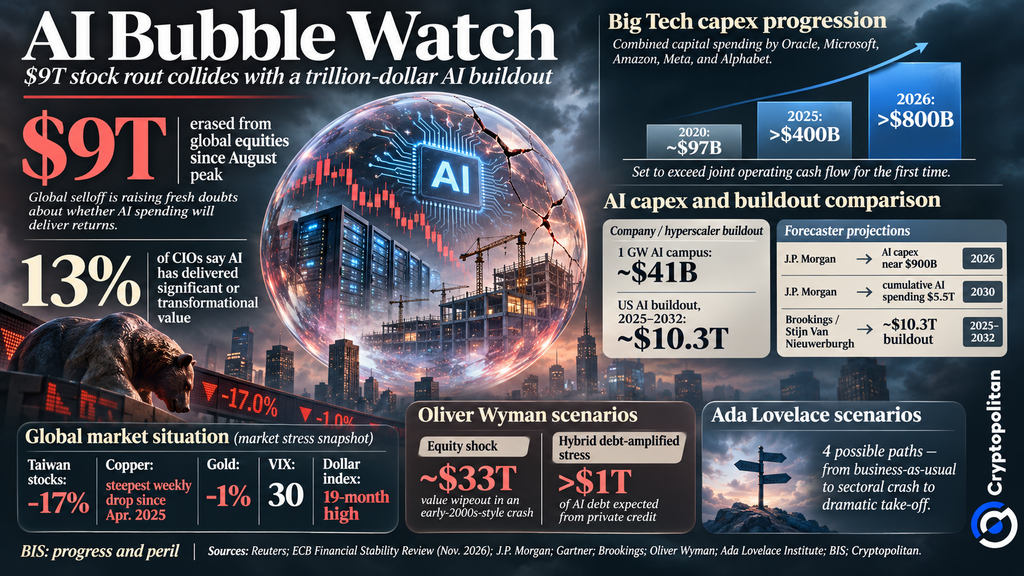
Global stock markets have lost nearly $9 trillion of their values since their peak in August 2026, as per Reuters. The situation deteriorated on November 20 and left investors with a very important question: will companies generate sufficient profit from artificial intelligence to get a return on their enormous investments?
But concerns go beyond AI investments. Persistent inflation and the prospect of further interest rate hikes have added to the pressure, especially as investors question whether technology stocks are overvalued.
A rout that runs wider than AI
The market turmoil is affecting much more than just the US technology stocks. Taiwan’s stock market dropped by 17% during the week ending November 20, which is its biggest drop since the early 1990s. Meanwhile, copper was set to record its worst week since April 2025, while gold dropped by around 1%.
The pressure reached currency and volatility markets as well. The dollar climbed to a 19-month high, while Wall Street’s VIX index, which measures expected stock market volatility, hit 30. Nvidia CEO Jensen Huang’s sudden resignation added to the uncertainty. Republican election losses also raised questions about the future of US data center projects.
Even gold, an investment that is usually used as a hedge against economic decline, was witnessing depreciation. Bruno Schneller of Erlen Capital Management noted in a statement to Reuters that the fall in the price of gold “may point to investors raising cash,” instead of transferring their money into safer investments.
The scale of the AI bet
Investors are also growing uneasy over the considerable amounts of money being spent on AI infrastructure.
According to J.P. Morgan, total AI expenditure around the world in 2026 will be near $900 billion. It can reach $5.5 trillion by the year 2030.
The US alone faces an enormous bill. In a Brookings analysis, economist Stijn Van Nieuwerburgh estimates that building AI infrastructure could cost $10.3 trillion between 2025 and 2032. A single one-gigawatt AI campus could cost around $41 billion.
Big Tech’s spending shows how quickly the costs are rising. Oracle, Microsoft, Amazon, Meta, and Alphabet spent a combined $97 billion in 2020, rising to more than $400 billion in 2025. Their spending could top $800 billion in 2026, exceeding their combined operating cash flow for the first time.
Spending that has yet to show returns
Despite the growing investments of Big Tech on AI, there has been little impressive return so far. According to a Gartner survey released on October 19, only 13% of CIOs stated that their companies benefited significantly from AI.
Gartner analyst Alicia Mullery warned that investing in more AI projects does not necessarily produce better results:
“Volume is not value. AI is creating a reckoning for organizations that lack fundamental disciplines”
Mullery emphasized the need to establish an AI project’s expected value before investing and to set clear rules for when to abandon projects that fail to deliver.
The financial strain is becoming harder to ignore. In a July 23 report, Cryptopolitan highlighted projections that five major cloud companies could spend more on infrastructure than they generate in free cash flow by 2027.
Alphabet offers a clear example. The Google parent recorded negative free cash flow of $5.9 billion in the June quarter, even as its 2026 capital spending forecast approached $205 billion.
How the debt could spread the damage
The risks extend further than the financial investments made by companies in AI. In fact, borrowing money for the purpose of expanding operations may create even greater dangers for the entire financial sector.
The review conducted by the European Central Bank in November 2026 cautioned about the potential impact of rising debts and complex financing mechanisms which could lead to losses related to AI being extended outside the technology sector to other areas. An analysis undertaken by IMF presented the effects through which risks might spread to companies and financial intermediaries involved in AI development.
Consulting firm Oliver Wyman described two possible scenarios. One scenario involves a sharp fall in AI-related stock prices. The other could be more damaging, as falling valuations trigger debt problems and further losses.
Oliver Wyman estimates that a crash similar to the early 2000s could wipe out around $33 trillion in market value. More than $1 trillion in AI debt is also expected to come from private credit, adding another potential source of financial risk.
Why a crash is not inevitable
Despite the growing debt risks, a downturn in AI stocks would not necessarily lead to a wider financial crisis.
In its September 2026 report, the Ada Lovelace Institute outlined four possible outcomes: business-as-usual, systemic crisis, sectoral crash, and dramatic technological acceleration. The BIS also acknowledged AI’s potential to support economic growth, while warning about the financial risks surrounding its rapid expansion.
AI investments are also starting to pay off. Cryptopolitan reported on July 23 that Microsoft’s AI annual recurring revenue had reached $37 billion. Amazon Web Services also reported 28% revenue growth in the first quarter.
But investors still want to know whether AI earnings can keep up with the billions being spent on infrastructure, while covering growing debt and supporting high stock valuations.
If you're reading this, you’re already ahead. Stay there with our newsletter.