
On November 19, 2026, US Representatives Sean Casten and Ted Lieu introduced H.R. 11092 that aims to give cash rewards to individuals who report insider trading in prediction markets.
The proposed legislation would allow whistleblowers to collect rewards if their information leads to the successful prosecution by the Justice Department of illegal activities in prediction markets. The introduction of the bill comes during a congressional investigation into suspicious bets related to military personnel, political candidates, and confidential government information.
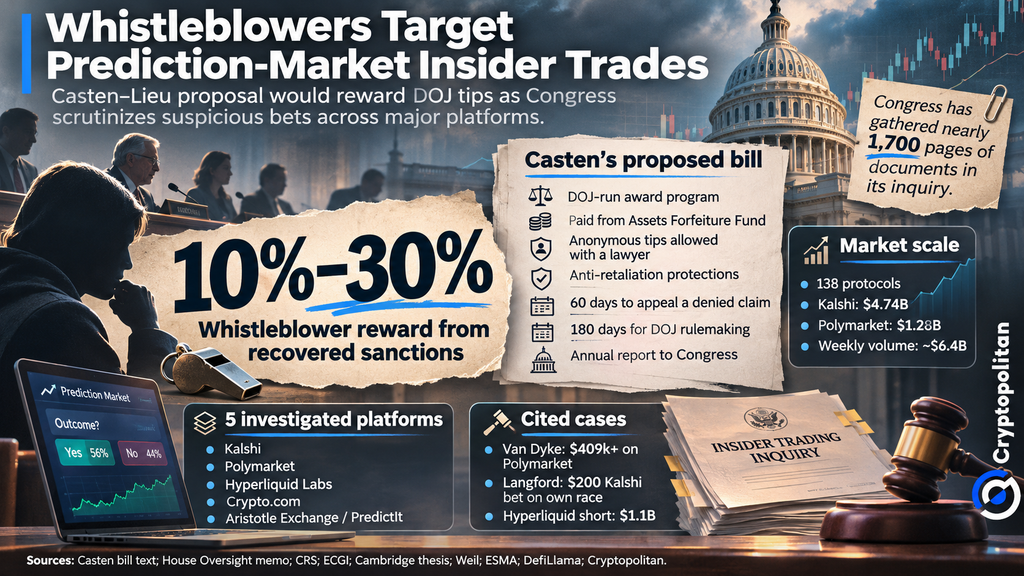
Cash rewards of up to 30% of sanctions
Under the proposed bill, whistleblowers could receive 10% to 30% of monetary sanctions recovered through successful enforcement actions. Payments would come from the Justice Department’s Assets Forfeiture Fund.
Whistleblowers could submit tips through their legal representatives without revealing their identities. Their employers would be prohibited from retaliating against them. Unsuccessful claimants would have two months to appeal the Justice Department’s decisions and would be able to turn to the courts for assistance.
The Attorney General would be required to set the terms of the program within 180 days of the law’s coming in force, with annual reports being prepared for Congress.
Nearly 1,700 pages and five platforms
The proposed whistleblower rewards come as the US Congress looks into dubious activity on prediction markets.
The House Oversight and Government Reform Committee began investigating Kalshi and Polymarket on May 22, 2026. On September 29, it expanded the inquiry to three more platforms: Hyperliquid Labs, Crypto.com and PredictIt’s parent company, Aristotle Exchange.
Based on a memorandum on November 13, the committee has collected almost 1,700 pages of documents and held five bipartisan briefings.
The memorandum highlighted several cases that raised suspicions of insider trading in prediction markets. One of the mentioned cases was that of Master Sergeant Gannon Ken Van Dyke of the United States Army who was indicted on April 24, 2026. The authorities claimed that he used classified military information to earn over $409,000 on Polymarket.
There is also the case of Kyle Langford, a candidate for governor in California. He placed a bet of $200 on his own race through Kalshi in May 2025. Another case was a $1.1 billion short position on Hyperliquid, placed ahead of a tariff announcement.
These cases show the challenges that regulators face. Even if a bet is suspicious, trading activity alone is not enough proof that someone has broken a law.
A bill, not a law
Despite growing concerns about insider trading, Congress has yet to approve the proposed whistleblower program.
H.R. 11092 was referred to House committees on November 19, 2026. It has not passed Congress.
On November 19, the Death Bets Act was approved by the US Senate. It targets prediction-market contracts involving death, terrorism, assassination, and war. Neither bill has become law.
Policing bets without killing the signal
In addition to the pending legislation, regulators must contend with another challenge: curbing insider trading while still allowing the kind of informed wagering that is central to prediction markets.
An analysis by the Congressional Research Service analysis released on April 3 notes that US derivatives law does not prohibit all nonpublic information trades.
Yale’s Jonathan Macey and Bocconi’s Luca Enriques raised a similar concern in an August paper. Prediction markets depend on informed traders to help estimate how likely an event is to happen. The researchers argue that regulators should restrict contracts vulnerable to corruption rather than broadly ban informed trading.
Proving insider trading is also difficult. A June Cambridge thesis used blockchain analysis to identify 16 of 22 previously reported insider-trading cases. However, unusual trading returns alone cannot prove that someone broke the law.
Compliance costs and a widening map
The debate over insider trading also affects companies. As regulators consider tougher oversight, companies may need to review their own rules on confidential information and employee trading.
In July, Weil advised US companies to extend their confidentiality and insider-trading policies to prediction-market contracts.
The market is growing, making oversight increasingly important. A November 20 DefiLlama snapshot counted 138 protocols with roughly $6.4 billion in weekly trading volume. Kalshi led with $4.74 billion, followed by Polymarket at $1.28 billion.
Concerns are not limited to the US. Europe’s ESMA raised concerns about market manipulation and investor risks in September.
Meanwhile, US regulators are still disputing who has authority over prediction markets. The CFTC is challenging states’ efforts to regulate event contracts. In November, CFTC Chair Michael Selig criticized state criminal actions against platform executives.
The Casten-Lieu bill could help authorities uncover insider trading. However, it could also mean higher compliance costs for platforms already navigating conflicting state and federal rules.
If you're reading this, you’re already ahead. Stay there with our newsletter.