 Written by Nate Kostarstaff writerEdited by Bryan O'Sheastaff editorWritten by Nate Kostarstaff writerEdited by Bryan O'Sheastaff editor
Wrapped Monero token crashes 99.8% amid suspected $13.5M exploit
Latest NewsPublishedNov 20, 2026Bitquery traced $13.5 million in suspicious sales of the wrapped Monero token, as its operator blamed a security breach and promised to reimburse affected traders.

A wrapped version of Monero (XMR) plunged more than 99% on Hyperliquid on Friday after a wallet that received tokens from the deployer account sold approximately $13.5 million worth of the asset, according to blockchain analytics firm Bitquery.
The token, known as XMR1, fell from around $500 to $1 in roughly 30 minutes, a 99.8% decline, according to Bitquery. Wrapped tokens are designed to represent other cryptocurrencies on different blockchains, allowing them to be traded outside their native networks. The collapse affected XMR1 rather than Monero’s native cryptocurrency.
According to Bitquery’s onchain analysis, the wallet received 5.2 million XMR1 tokens from the deployer account before selling approximately $13.5 million worth of the asset on Friday.
The firm traced $13.28 million in USDC transferred to Arbitrum, where $13.22 million was exchanged for 7,467 Ether (ETH) through CoW Protocol. Most of the ETH was subsequently bridged to Ethereum.
Bitquery also found that proceeds from four hacks earlier in November, involving Across Protocol, Kava, Lighter and Safe, had been used to purchase approximately $6.6 million worth of XMR1, apparently as a route to native Monero. The firm said it found no onchain evidence linking those incidents to Friday’s suspected exploit.
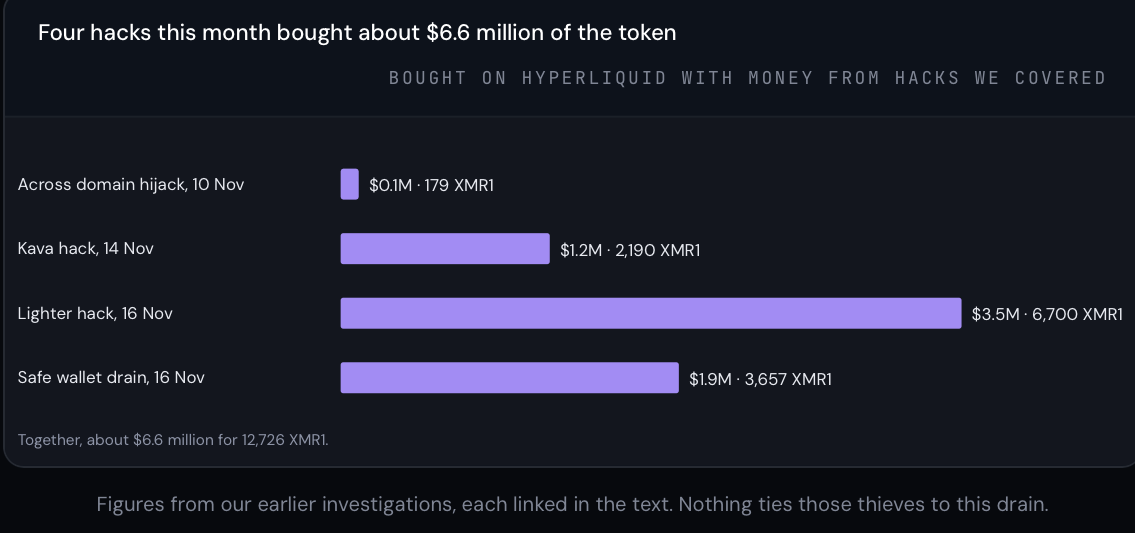
Value of XMR1 purchases linked to funds from four November hacks. Source: Bitquery
Bitquery said its onchain investigation could not establish how the deployer account’s private key was obtained or who controlled it during the transfers, leaving the circumstances of the suspected compromise unconfirmed.
Related: Binance hacker moves nearly $600M in ETH, routes funds through THORChain, Chainflip
Wagyu operator blames suspected infrastructure breach
PerpetualCow, the pseudonymous operator of Wagyu, the service behind XMR1, attributed the collapse to an alleged breach of hosting provider 1984, claiming that customer data and internal server files had been exposed.
According to PerpetualCow, the XMR1 deployer key had been stored on a server that was subsequently deleted, but the hosting provider allegedly retained logs and files associated with it.
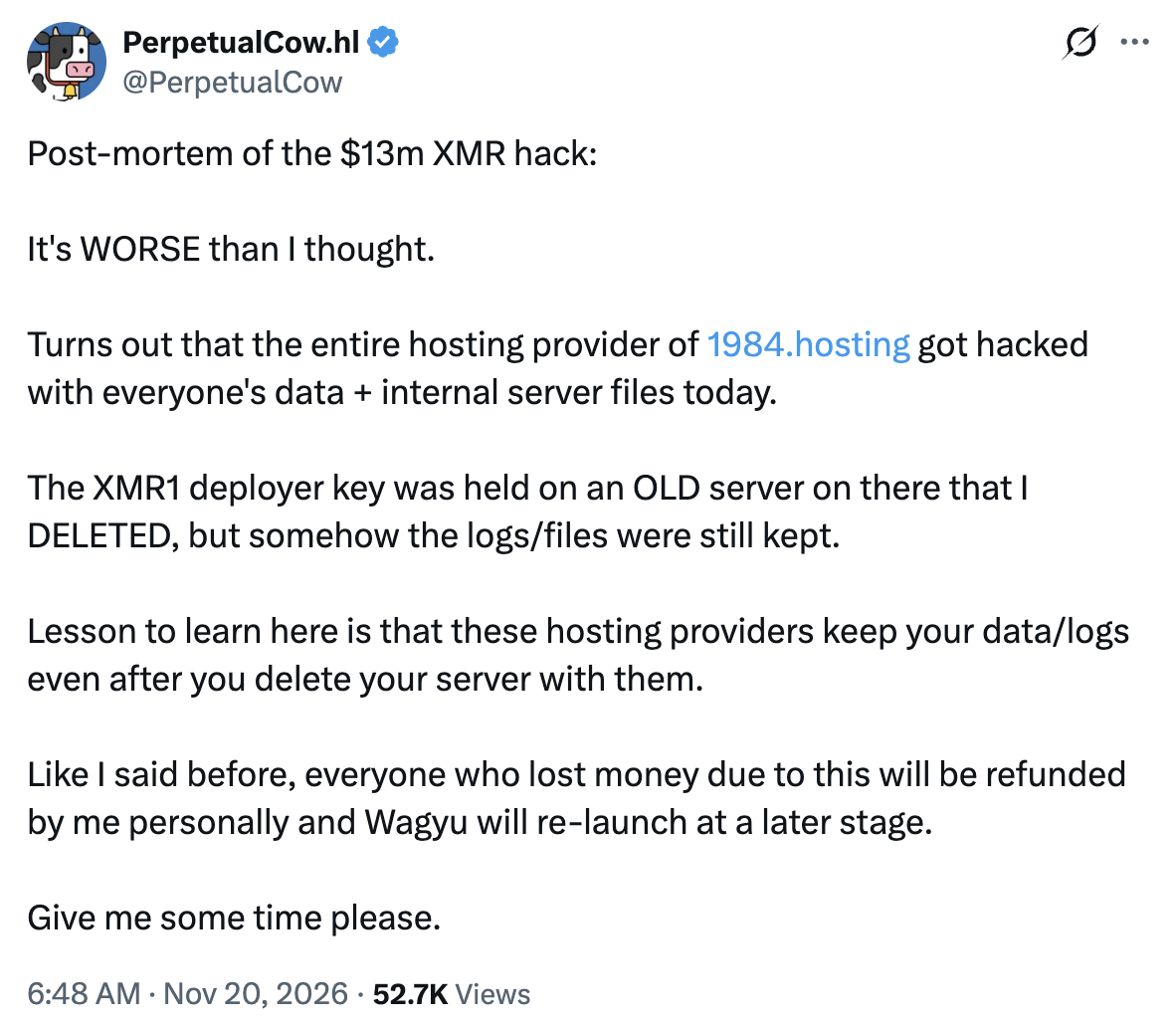
Source: Perpetual Cow
PerpetualCow also pledged to personally reimburse affected traders and said Wagyu would relaunch at a later date, although no timeline was provided.
Cointelegraph contacted the operator for additional details about the suspected breach and reimbursement plans but had not received a response by publication.
Magazine: Binance’s $6.5B freeze order, Hong Kong ‘suspicious’ of HYPE: Asia Express


Get the day’s top crypto stories in a quick, daily read.
Subscribe Cointelegraph is committed to independent, transparent journalism. This news article is produced in accordance with Cointelegraph’s Editorial Policy and aims to provide accurate and timely information. Readers are encouraged to verify information independently.More on the subject
Binance hackers stole 192 tokens across 11 networks, court docs show
Nov 19, 2026Felix NgTrump administration unveils new center to choke off scam payments
Nov 19, 2026Felix NgLedger warns Berlin customers as hardware wallet tampering investigation expands
Nov 18, 2026Nate KostarBinance hackers stole 192 tokens across 11 networks, court docs show
Nov 19, 2026Felix Ng
Trump administration unveils new center to choke off scam payments
Nov 19, 2026Felix Ng