
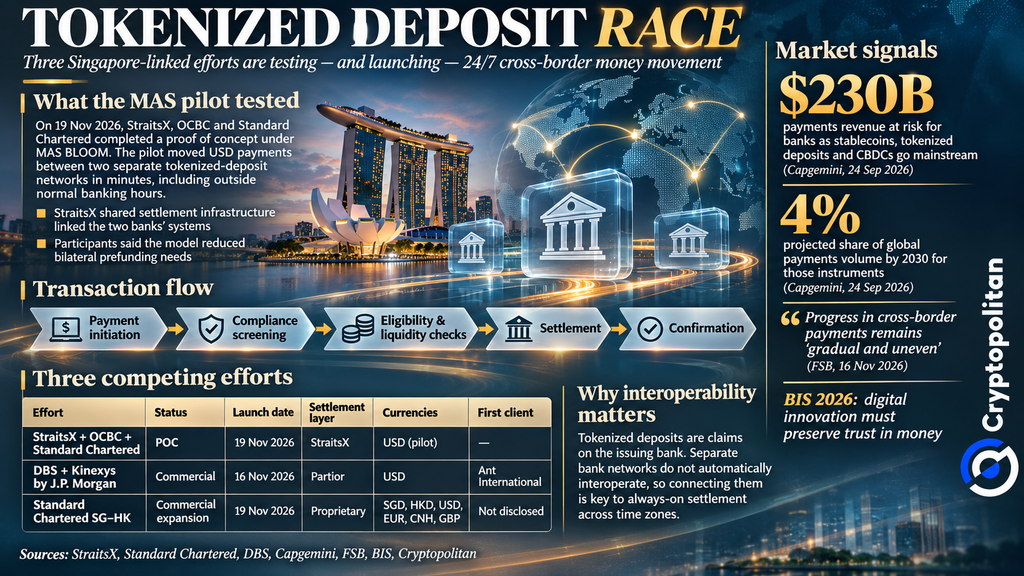
StraitsX, OCBC and Standard Chartered successfully tested US dollar payments between their separate tokenized deposit networks. The payments took just minutes to complete, even outside regular banking hours.
The three companies announced the results on November 19, 2026. The test was conducted under the Monetary Authority of Singapore’s (MAS) Borderless, Liquid, Open, Online, Multi-currency (BLOOM) initiative.
The test focuses on a key challenge in digital banking. Tokenized deposits are tied to the banks that issue them. Although the money can circulate within one bank’s network, moving anything to another bank’s network will pose some challenges. Banks must first come up with ways to connect these separate networks before they can support seamless transfers.
Why separate deposit networks can’t talk
StraitsX used its shared settlement infrastructure to connect OCBC’s and Standard Chartered’s tokenized deposit networks. Each payment went through five steps: initiation, compliance screening, eligibility and liquidity checks, settlement, and confirmation.
According to StraitsX, the payments were completed within minutes. The banks also found they could reduce bilateral prefunding, which requires them to set aside money with each other before making payments.
The findings support a key goal outlined in the MAS BLOOM use cases: allowing different forms of digital money to work together across banking systems.
A proof of concept, not a live product
It is one thing to pass a successful test. It is a wholly different one to provide the service to customers. Banks must do a lot of work before launching: make sure that settlements are legally final, deal with liquidity risks, define responsibilities, and improve protection against financial crime.
These challenges influence the whole banking sector. The analysis of the Asian Banker in November 2026 also pointed to settlement arrangements, as well as liquidity management, as obstacles to wider adoption.
DBS and Kinexys reached the market first
While StraitsX, OCBC and Standard Chartered were busy exploring interoperability, other banks have been busy with launching similar services.
On November 16, 2026, DBS and Kinexys by J.P. Morgan launched a commercial service allowing US dollar transfers between blockchain-based accounts in Singapore and the United States, 24 hours a day. Ant International became its first client.
Three days later, Standard Chartered expanded its own tokenized deposit service to support near-real-time transfers between Singapore and Hong Kong. The service supports six currencies: SGD, HKD, USD, EUR, CNH and GBP.
Banks had already made progress earlier in the year. In September, Cryptopolitan reported that DBS and Citi completed a weekend dollar transfer between Singapore and New York in minutes using SWIFT’s Digital Ledger.
Why banks are racing to connect
Banks have good reason to invest in faster payment networks. On September 24, 2026, Capgemini estimated that banks could lose $230 billion in payments revenue as digital alternatives gain ground. Its research projects that stablecoins, tokenized deposits and central bank digital currencies could account for about 4% of global payments volume by 2030.
A November 2026 GFTN report examined the growth of tokenized markets. However, faster cross-border payments remain a work in progress.
In its November 16, 2026 report, the Financial Stability Board found that progress in making cross-border payments faster and more efficient remained slow and uneven. The Bank for International Settlements raised another concern in June 2026: new digital payment systems must maintain people’s trust in money.
Banks are now faced with the challenge of creating systems that would not just transfer funds in seconds. They also need to demonstrate that their systems are secure, legally reliable, and commercially viable.
Don’t just read crypto news. Understand it. Subscribe to our newsletter. It's free.