Can AI Hack Smart Contracts? How AI Agents Are Changing Blockchain Security
Guides By Arman Shirinyan Nov 19, 2026 AI agents can already find and exploit smart contract vulnerabilities in tests, so DeFi teams need stronger defenses.Advertisement

- How AI Agents Find Vulnerabilities
- Hacks and Losses in 2026
- Benchmarks and Experiments
- What Teams Should Do
How AI Agents Find Vulnerabilities
Smart contract vulnerability scanners typically work by looking for certain patterns. However, because an AI agent can iterate and make use of dependencies, local blockchain forks, and decompilation, it weakens the protection gained by keeping source code secret, and can attempt attacks against complex vulnerabilities such as access control bugs, accounting errors, oracle-related bugs and unexpected contract interactions.
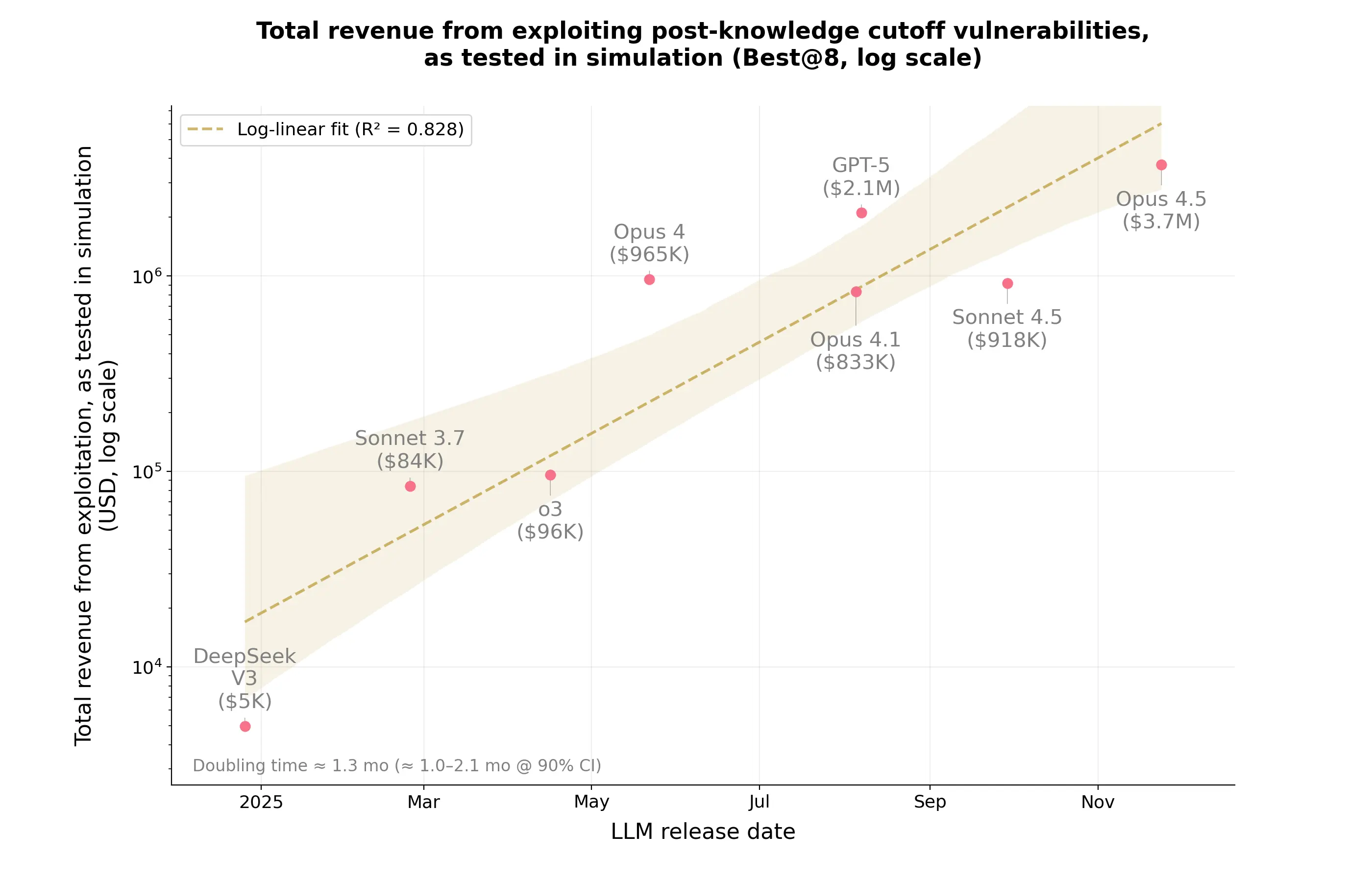
For example, in December 2025, Anthropic released results from SCONE-bench, a smart contract benchmark of 405 contracts that were exploited in the 2020 - 2025 period. They were able to reproduce exploits for 207 contracts, totalling $550.1 million (simulated stolen funds).
To make sure the agent was not simply memorising exploits that were already published, newer vulnerabilities that had been published after their training cutoff were tested on Claude Opus 4.5, Sonnet 4.5, and GPT-5, which were able to generate $4.6 million (simulated stolen funds).
HOT Stories Gonka AI Hit by $1 Million Exploit as Hacker Drains Stablecoins Bitwise CEO Urges Americans to Hold Crypto as Banking Giants Go DownFinally, they analysed 2,849 recent smart contracts with no known issues, discovering two previously unknown vulnerabilities that could have resulted in $3,694 (simulated stolen funds), emphasising the ability of AI agents to discover new vulnerabilities rather than simply exploiting known ones.
AdvertisementAnthropic emphasised that no actual funds were lost during these experiments. It should also be noted that in one of their experiments using GPT-5, it cost $3,476 for API usage, which leaves a slim (simulated) profit.
Hacks and Losses in 2026
With automated hacking becoming more effective, how can we be sure that DeFi will be able to stay ahead of these AI agents? Hacken, a blockchain security firm, reported that $1.18 billion was lost in 107 crypto hacks during the third quarter of 2026. 48% of this was from exploiting smart contracts.
Of course, this doesn’t specify the cause of these hacks. Regardless, it emphasises the importance of being able to stay ahead of AIs which could be used for exploitation.
Advertisement
Chainalysis estimates that approximately $36.7 million was stolen in 2026 from DeFi protocols that had not undergone smart contract verification. It also notes AI-assisted reverse engineering as an emerging risk without attributing any particular thefts to AI.
In an experiment by a16z on 20 past DeFi price manipulation exploits, apparent success rates of 50% were reduced to 10% when the researchers restricted access to transactional data that revealed the original exploit. When the researchers gave the AI some high-level information about the DeFi domain, success rates jumped to 70%.
Benchmarks and Experiments
In February 2026, OpenAI and Paradigm released a benchmark for evaluating agents’ abilities in the domains of vulnerability detection, patching, and exploitation using an EVM environment (EVMbench). Results showed that GPT-5.3-Codex achieved a 71% success rate in exploitation (limited to a sandboxed environment) and 33.3% for GPT-5.
In October 2026, CyberChainBench was released, analyzing 541 exploit events across 9 Ethereum-compatible blockchains. The best-performing configuration achieved 37.5%, 43.7%, and 23.4% success rates for detection, exploitation, and patching respectively.
In a simulation, the best-performing agent profited $57.4 million from exploits on 200 exploit events that occurred after the cutoff. Some of the reported high-severity issues were evaluated and determined to not be exploitable by OpenZeppelin. Since much of the data is trained on in the public, results may be exaggerated.
What Teams Should Do
Agents will continue to improve, and while current results are not an indication that AI-driven agents are responsible for large scale on-chain thefts, it is an indication that AI can find and exploit weaknesses in smart contracts given a certain environment. Given the ease with which agents can try attacking many different protocols, smaller protocols may see an uptick in exploit attempts.
Teams that implement rigorous testing and monitoring could have an edge over other teams. For example, AI could be used to test a contract prior to deployment, generate regression tests, and identify weird behavior on-chain. A human would still need to verify any potential issues and sign off on changes.
Teams should continue to perform third-party audits and implement other security best practices such as limiting access to sensitive information, setting up alerts and response plans, restricting the amount of money in a wallet, making sure AI systems do not have permissions to transact without human oversight where necessary, and so on.
#Blockchain #AI Agents#AI#Anthropic#OpenAI- How AI Agents Find Vulnerabilities
- Hacks and Losses in 2026
- Benchmarks and Experiments
- What Teams Should Do
Related articles
NewsNov 19, 2026 CZ Sounds Alarm as Japan Orders Crackdown on ID Data StorageByAlex DovbnyaNewsNov 18, 2026 Gonka AI Hit by $1 Million Exploit as Hacker Drains StablecoinsByAlex DovbnyaAdvertisement AdvertisementLatest Press releasesAI Agent Marketplace for Business | ASCN.ai Private AI DinnerCrypto Arbitrage Without API Keys | ArbitrageScanner x CoinW EventMore Than a Swap: PancakeSwap Rebrands as Pancake Ahead of Mobile App LaunchAdvertisement
Recommended articles
GuidesNov 19, 2026 Can AI Hack Smart Contracts? How AI Agents Are Changing Blockchain SecurityInterviewsOct 2, 2026 'Your Wallet Doesn't Decide When You Need Your Backup': Trezor Analyst on the Fake App ProblemInterviewsSep 25, 2026 From Post-Quantum Cryptography to AI: QoreChain Founder Liviu Epure on the Future of BlockchainOpinionsSep 15, 2026 Clarity Act Fails Again: What It Means for CryptoReviewsSep 11, 2026 QoreChain Review: Post-Quantum Security With Triple-VM BlockchainPrice IndexBitcoin (BTC) Price IndexEthereum (ETH) Price IndexXRP Price IndexCardano (ADA) Price IndexDogecoin (DOGE) Price IndexShiba Inu (SHIB) Price IndexTron (TRX) Price IndexPolygon (POL) Price IndexLitecoin (LTC) Price IndexSolana (SOL) Price IndexZcash (ZEC) Price IndexHyperliquid (HYPE) Price IndexOur social mediaThere's a lot to see there, too Popular articlesGuidesNov 19, 2026
Can AI Hack Smart Contracts? How AI Agents Are Changing Blockchain SecurityBlockchain AI AgentsAIAnthropicOpenAIArman ShirinyanNewsNov 19, 2026
CZ Sounds Alarm as Japan Orders Crackdown on ID Data StorageChangpeng ZhaoBinanceCrypto RegulationAlex DovbnyaNewsNov 18, 2026
Gonka AI Hit by $1 Million Exploit as Hacker Drains StablecoinsEthereum NewsAlex DovbnyaShow allAdvertisement
Subscribe to daily newsletter
AdvertisementAD