
 The payment rail for your crypto. One card. Every chain. No KYC. Spend with Apple Pay or Google Pay in 180+ countries.
S&P Global Ratings has maintained its stablecoin stability assessment of Tether’s USDT at the lowest level on its five-point scale, warning that growing exposure to higher-risk assets could leave the world’s largest stablecoin undercollateralized during a market downturn.
Summary- S&P maintained USDT’s weakest stability score as higher-risk asset exposure hit 28%.
- Tether’s gold holdings reached $19B while public equity investments rose to $4.2B.
- Tether reported $191.45B in assets against $183.50B in liabilities in September.
- S&P flagged transparency concerns despite Tether completing its first KPMG audit.
- Tether rejected S&P’s stability assessment and criticized its evaluation framework.
In its Nov. 18 assessment, S&P assigned USDT a score of 5 (weak), unchanged from November 2025, after finding that assets it considers higher risk were equivalent to 28% of circulating USDT as of Sept. 30, compared with 24% a year earlier.
The assessment measures a stablecoin’s ability to maintain its dollar peg and does not constitute a formal credit rating.
However, Tether rejected the findings, arguing that shortcomings in S&P’s methodology were responsible for the unfavorable assessment.
“The problem is S&P’s framework, not our reserves,” the company told Cointelegraph, referring to the 2008 financial crisis and its portrayal in the film The Big Short when criticizing the agency.
You might also like: Tether’s Paolo Ardoino backs RGB for Bitcoin tokenizationTether’s exposure to gold and equities grows
S&P identified changes in Tether’s reserve composition over the past year, particularly its growing investments in gold and publicly traded stocks, despite a reduction in its Bitcoin exposure.
Gold holdings rose from $12.9 billion in September 2025 to approximately $19 billion a year later, while Bitcoin holdings declined from $9.9 billion to $8.4 billion. Tether introduced $4.2 billion in public equity investments during the same period.
The agency’s higher-risk asset category includes corporate bonds, secured loans and other investments exposed to fluctuations in market prices, interest rates and the creditworthiness of borrowers.
“A significant drop in the value of these assets could lead to USDT being undercollateralized,” S&P warned.
Nevertheless, Tether’s reserves continued to exceed its outstanding obligations at the end of September. Its latest financial figures, attested by BDO Italia, showed $191.45 billion in assets against $183.50 billion in total liabilities, giving the issuer a collateralization ratio of 104.3%.
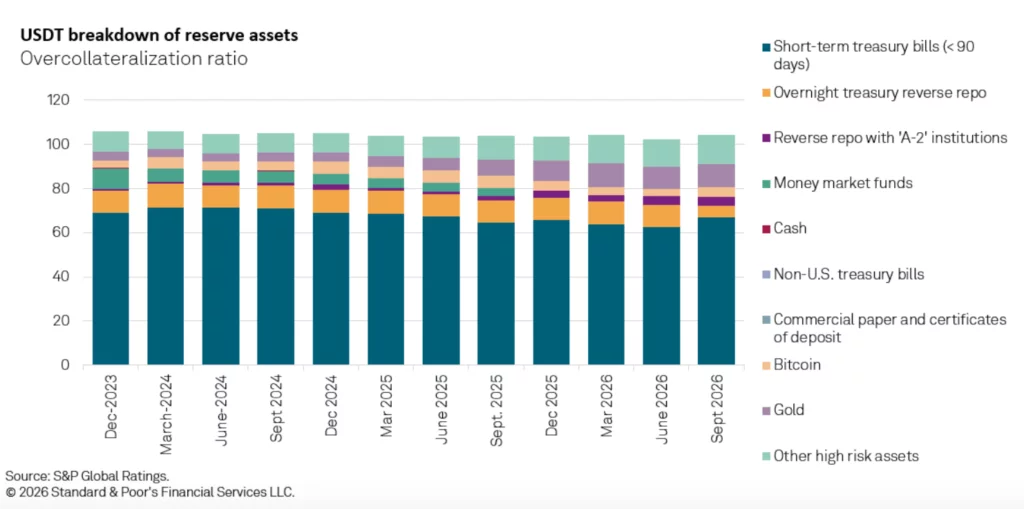
As crypto.news previously reported, Tether’s excess reserve buffer nearly doubled from $4.11 billion at the end of June to $7.95 billion at the end of September, alongside quarterly net operating profit of $1.5 billion.
The company’s direct and indirect exposure to U.S. Treasury bills stood at $132.4 billion, with Treasury bills and reverse repurchase agreements generating most of its operating income.
However, S&P noted that the value of higher-risk assets substantially exceeded the available reserve surplus.
S&P questions Tether’s financial disclosures despite KPMG audit
Reserve transparency remains another point of disagreement between the stablecoin issuer and the ratings agency.
In August, Tether announced the completion of its first full independent audit, with KPMG U.S. issuing an unqualified opinion on its financial statements for the year ended Dec. 31, 2025.
The audit examined financial transactions, asset valuations, ownership records and counterparty information. Tether said KPMG physically inspected and counted every gold bar held by the company.
Despite the audit’s completion, S&P noted that the financial statements, accompanying notes and auditor’s report remained unavailable to the public, limiting its ability to examine the underlying information.
Tether’s quarterly reserve reports do not identify its custodians, banking partners or counterparties. S&P found that disclosures concerning the composition and credit quality of secured loans and corporate bonds remained insufficient.
The company’s CEO, Paolo Ardoino, had previously criticized S&P’s assessment after the agency lowered USDT’s stability score from 4 to 5 in November 2025.
El Salvador’s regulatory framework draws scrutiny
S&P questioned the legal protections surrounding USDT’s reserves following Tether’s relocation from the British Virgin Islands to El Salvador in 2025.
The company operates under the supervision of El Salvador’s National Commission of Digital Assets, which requires stablecoin issuers to maintain at least one dollar in reserve assets for every dollar of stablecoins issued.
At least 70% of those reserves must be invested in assets that can be liquidated within 30 days.
However, S&P considers the framework less stringent than its European and U.S. counterparts because it permits exposure to assets such as Bitcoin, gold and loans without requiring reserve segregation.
The agency found insufficient public information to determine how USDT’s reserves would be protected against issuer insolvency or financial difficulties arising from Tether’s other business ventures, which include artificial intelligence and Bitcoin mining.
Tether maintains that its non-stablecoin operations are managed separately from USDT’s reserves.
USDT maintains price stability despite redemption limitations
Although S&P retained its weakest assessment, the agency acknowledged USDT’s history of maintaining its dollar peg, particularly over the past 12 months.
Direct redemptions remain limited to verified customers holding at least $100,000 in Tether tokens. The issuer’s official fee schedule specifies a $150 verification charge and a redemption fee of $1,000 or 0.1%, whichever is higher.
S&P noted that strong liquidity across centralized and decentralized exchanges partially offsets these restrictions, although direct redemption payments remain constrained by conventional banking hours.
As of Oct. 25, Tron accounted for 50.7% of circulating USDT, followed by Ethereum at 46.8% and Solana at 1.6%, with the three networks collectively hosting 99.1% of the stablecoin’s circulating supply.
Read more: Bitcoin price erases its summer rally gains, how much further could BTC fall?US crypto regulation hub
Crypto mining in the US: federal rules and the state map
Crypto kiosk rules by state: bans, licenses and the fraud data
Crypto ETF rules in the US: how a fund gets listed now
Crypto banking access in the US: master accounts, the chokepoint, and what changed
CFTC and crypto in 2026: what the agency now governs
Is crypto legal in the US? Yes, and here is the structure
Crypto executive orders: what the White House has actually ordered
SEC crypto enforcement in 2026: from registration war to fraud beat
IRS crypto tax rules in 2026: what actually gets taxed
The OCC and crypto: national trust charters, explained
View allDeep Dives
 Feature
Read more - Zcash price prediction as ZEC rebounds. Is $1,000 within reach?
Zcash price prediction as ZEC rebounds. Is $1,000 within reach?
 ZEC
Zcash
22 hours ago
 Feature
Read more - BNB price prediction as the token struggles to recover $600
BNB price prediction as the token struggles to recover $600
 BNB
BNB
22 hours ago
 Feature
Read more - PEPE price prediction after a near-30% weekly drop. What comes next?
PEPE price prediction after a near-30% weekly drop. What comes next?
 PEPE
Pepe
23 hours ago
 Feature
Read more - Tron price prediction as TRX holds above $0.30 during the sell-off
Tron price prediction as TRX holds above $0.30 during the sell-off
 TRX
TRON
23 hours ago
 Feature
Read more - Your crypto trading bot can lose money without withdrawal access
Your crypto trading bot can lose money without withdrawal access
2 days ago Feature
Read more - Monero hides payments. How do you prove you paid someone?
Monero hides payments. How do you prove you paid someone?
 XMR
Monero
2 days ago
 Feature
Read more - Why does a failed Solana trade still take money from your wallet?
Why does a failed Solana trade still take money from your wallet?
 SOL
Solana
2 days ago
 Feature
Read more - Small Bitcoin withdrawals can leave you with a bigger bill later
Small Bitcoin withdrawals can leave you with a bigger bill later
 BTC
Bitcoin
2 days ago
 Feature
Read more - Ondo stock-backed loans charge no interest. Borrowers give up upside
Ondo stock-backed loans charge no interest. Borrowers give up upside
 ONDO
Ondo
3 days ago
 Feature
Read more - Trezor found implants in reseller wallets. What protects the buyer?
Trezor found implants in reseller wallets. What protects the buyer?
3 days ago News
Read more - Stablecoin supply falls $16 billion as Bitcoin slides
Stablecoin supply falls $16 billion as Bitcoin slides
11 hours ago News
Read more - Tangem executive sees stablecoin growth in 2027, doubts altcoin season
Tangem executive sees stablecoin growth in 2027, doubts altcoin season
14 hours ago News
Read more - Japan’s yen stablecoin issuer JPYC extends app outage with no recovery date
Japan’s yen stablecoin issuer JPYC extends app outage with no recovery date
20 hours ago