Leopold Aschenbrenner is considering a comeback after four months following the near collapse of his AI hedge fund. The Financial Times says “Situational Awareness 2.0” could see new investors coming in and borrowing resuming. But it is yet to be seen whether his lenders would have faith in his risk management practices.
What “Situational Awareness 2.0” would actually require
Although no plans have been finalized, Situational Awareness is already expanding its operations. The fund now has about 30 employees, up from eight in June. It is looking for a chief risk officer.
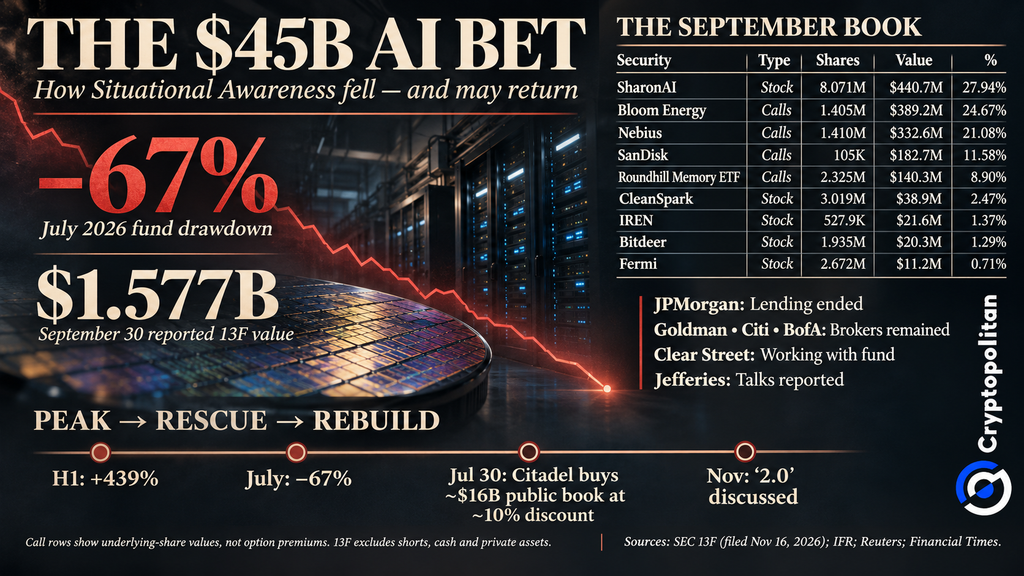
Aschenbrenner is considering raising more money from outside investors in 2027. However, securing bank support could prove more difficult. Reuters reported that JPMorgan stopped lending after July’s losses. Goldman Sachs, Citigroup and Bank of America remained brokers, while Clear Street also works with the fund. Jefferies had earlier turned the fund away over concerns about how it hedged its bets. The bank is now back in talks with Aschenbrenner, but no deal has been announced.
The bets the September filing shows
The fund’s November 16 SEC filing gives a snapshot of its public-market bets after July’s selloff. As of September 30, it reported $1.577 billion in securities across 23 entries and nine issuers. SharonAI led the list, with 8.07 million shares worth $440.67 million, or 27.94% of the total.
The fund’s other stock holdings included CleanSpark, IREN, Bitdeer and Fermi. In addition to that, it had call options in Bloom Energy, Nebius, SanDisk, and the Roundhill Memory ETF. The value of calls is based on the price of the underlying assets, instead of premiums that were paid for them. The filing does not account for cash, short positions, and private holdings. Therefore, the $1.577 billion does not comprise the fund’s total assets.
From a $45 billion peak to a Citadel rescue
At its peak, Situational Awareness had an estimated $45 billion in assets. The fund gained 439% in the first half of 2026, according to an investor letter cited by IFR.
July was a different story. AI stocks the fund owned fell, while software shares it had bet against rose. Heavy borrowing made the losses worse. By the end of July, the fund had lost 67% of its value.
As lenders demanded more collateral, Aschenbrenner sold most of a roughly $16 billion public-stock portfolio to Citadel. The sale took place before markets opened on July 30, at about a 10% discount. The fund kept around $10 billion in mostly private investments, including an Anthropic stake valued at roughly $5 billion.
The memory-chip concentration behind the drawdown
Concentration deepened the losses. As Cryptopolitan reported, SanDisk and Micron made up nearly half of the fund’s June US stock holdings. Both were bets on AI demand for memory chips.
Yet Aschenbrenner remains committed to semiconductors. The fund invested $400 million in Source Foundry, a chip-equipment startup valued near $5 billion. He spotted an opportunity but struggled to finance it safely.
Regulators and economists are watching crowded AI trades
The SEC subpoenaed banks for information about the fund’s trades and leverage. That does not establish wrongdoing. According to IFR, margin adjustments and claims against public and private holdings protected lenders. The European Central Bank cited Situational Awareness when warning that crowded, leveraged AI trades can trigger forced selling. Federal Reserve Governor Michael Barr raised concerns about debt-funded data centers. The IMF warned leverage could worsen an AI selloff. And Brookings projects $10.3 trillion in AI infrastructure investment from 2025 to 2032, increasingly funded through opaque financial structures.
The smartest crypto minds already read our newsletter. Want in? Join them.