
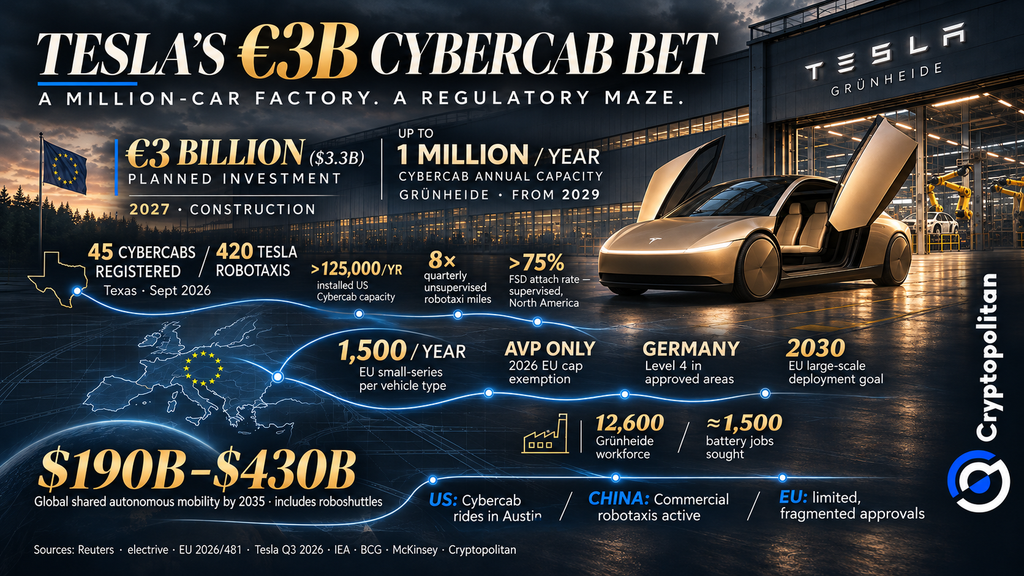
Tesla plans to produce up to one million Cybercab robotaxis a year at its factory in Germany. The company intends to invest €3 billion ($3.3 billion) and to start production in 2029. How those vehicles fare in deployment throughout Europe remains to be seen.
A new hall built for a million robotaxis a year
To make room for increased Cybercab production, Tesla plans to expand its Grünheide factory near Berlin. The project includes a second production hall, battery facilities, logistics buildings and wastewater treatment.
With the expansion, Tesla’s Grunheid factory could become the largest car plant in Germany, overtaking Volkswagen’s car plant in Wolfsburg. According to Electrive, Tesla is likely to submit its construction application by the end of 2026, and construction could start in the first half of 2027.
Tesla has increased its Grünheide factory workforce from about 11,000, as seen during the downturn in sales from 2024 to 2025, to approximately 12,600. In addition to this, the company plans to hire several hundred workers for the factory expansion and to recruit an additional 1,500 workers for battery production as well.
Brandenburg premier Dietmar Woidke has approved the additional investment, describing it as “a decision of enormous economic significance.” Meanwhile, automotive expert Matthias Schmidt has raised doubts about how much of that investment will generate “sustainable, long-term employment” instead of jobs requiring low labor and automation.
Where EU rules still stand between the plant and the road
Producing Cybercabs is one challenge, but securing the proper permits to operate them is an entirely different matter. For Tesla to legally operate the Cybercabs, it will need to obtain a vehicle type approval that is required to ensure the vehicle design passes safety regulations. Under Regulation 2026/481 of the European Union (EU), the small-series approval system restricts registrations to only 1,500 fully autonomous vehicles per type each year. In March 2026, the EU lifted the 1,500-vehicle annual cap for automated valet parking, which allows cars to park themselves at low speeds. However, the restriction still applies to urban robotaxis.
Vehicle approval itself does not mean that commercial use is allowed. In Germany, Level 4 autonomous vehicles have already been approved, meaning they can operate without human involvement in specific areas or conditions. However, according to the European Parliament, the operating routes still require approval of local and national authorities.
The goal of the EU is to implement autonomous vehicles on a wider scale by 2030. But international safety standards adopted in June 2026 are still not part of EU law. Until there is more uniformity in the laws among EU member states, it is possible that Tesla will face problems when it expands its robotaxi services in Europe.
What Tesla can actually show so far
The Q3 update from Tesla has confirmed that Cybercab rides were launched in Austin on September 3. The annual capacity of Cybercab is now more than 125,000 rides and there has been an increase of eight times from the previous quarter in miles traveled by unsupervised robotaxis. However, Tesla has not mentioned any sales, fleet utilization, or revenue from rides conducted by Cybercab. The Full Self-Driving software is installed in around 75% of new shipments to North America and requires the presence of a driver inside the car.
In September, Texas had registered only 45 Cybercabs among roughly 420 Tesla robotaxis, Cryptopolitan reported. Those are numbers for the month of September and not a current fleet count. Tesla welcomes commercial purchase inquiries, but not general consumer sales.
Why the clock favours the US and China
Tesla’s limited Cybercab rollout comes as commercial robotaxi services expand elsewhere. The IEA says most operate in the US and China. Europe has also made a start, with services in Zagreb and supervised rides in London, according to McKinsey. However, differing national regulations make expansion across Europe more difficult.
BCG analyst Markus Hagenmaier and coauthors write that “robotaxi adoption will be evolutionary rather than revolutionary.” Their research expects Europe to lag behind the US and China as operators navigate different approval requirements.
McKinsey analyst Ani Kelkar and colleagues ask, “How can we scale shared AVs safely and profitably?” They estimate that the global market for shared autonomous mobility, including robotaxis and larger driverless shuttles, could reach $190 billion–$430 billion by 2035.
Tesla could benefit from that growth. But until European regulations become more consistent, early fleet contracts and revenue may favour the US and China.
The smartest crypto minds already read our newsletter. Want in? Join them.