
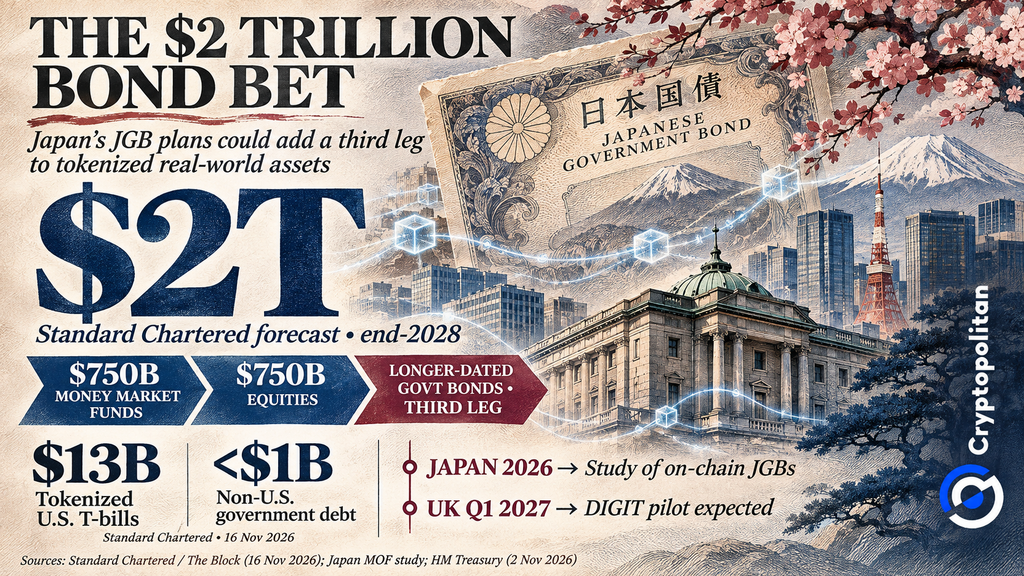
Standard Chartered thinks Japan’s bond-tokenization experiment will positively impact its $2 trillion projections. In a note from November 16, 2026, Geoffrey Kendrick, Global Head of Digital Assets Research at Standard Chartered, projected that the total value of tokenized real-world assets (RWA), excluding stablecoins, could expand from nearly $45 billion to $2 trillion by the end of 2028.
The two pillars behind the $2 trillion call
The estimation made by Standard Chartered relies mainly on money market funds and equities worth $750 billion each. Long-dated sovereign bonds could be another option.
Kendrick estimates that as of November 16, there are $13 billion worth of tokenized U.S. Treasury bills and less than $1 billion worth of non-U.S. government bonds. If Japan reduces costs for bond trading, other countries would possibly follow its lead. This is the Standard Chartered’s forecast, not Japan’s target.
Three doors into on-chain JGBs
Japan is considering three options regarding Japanese Government Bonds (JGBs) but has not yet opted for any of them. Following the discussions held on October 8 and October 30, Japan’s Ministry of Finance is exploring the idea of tokenizing the rights to JGB assets, performing transfers through blockchain technology in the existing book-entry system, or possibly even developing a bond based on blockchain technology. According to the report from Cryptopolitan, the officials could finalize the discussions by December 2026 or January 2027.
Why the repo market is the real prize
Japan’s repo market presents an opportunity for blockchain, to move collateral through different time zones. According to Progmat’s interim report from October 22, the market is at least ¥250 trillion and proposes that bilateral repos can be settled all around the clock outside of a central counterparty (CCP). Repos help institutions in raising funds through selling bonds and repurchasing them later. Progmat intends to test the idea of round-the-clock settlement in its Canton Network sandbox. Michio Saito mentioned on October 19 that if JGB collateral is transferred during non-business hours in Japan, it will lead to greater international use of yen in transactions.
As reported by the Financial Stability Board (FSB), the estimated amount related to repos backed by government bonds reached $16 trillion by the end of 2024. About 10% of the aforementioned amount will come from the Japanese economy, while a little less than 40% will get cleared centrally. In addition, the FSB has spoken against possible leverage and liquidity related risks.
Short-dated funds still dominate what exists today
Today’s tokenized Treasury market remains short-dated and thinly traded. Dune’s Q3 2026 report found over 95% of Treasury exposure in bills and money funds. Just 0.006% of cash-equivalent supply traded in August. Four tracked asset classes reached $33.9 billion, up over 140% year-on-year. Yet 19–21% of tokenized credit sat in lending protocols, compared with 0.4% of cash equivalents.
As of November 16, 2026, RWA.xyz showed $39.52 billion in distributed tokenized assets excluding stablecoins, down 1.69% in 30 days. Different methodologies help explain the gap from Kendrick’s baseline.
London’s gilt pilot and the limits of the thesis
The UK is closer to a digital government bond pilot than Japan, although savings remain unproven. HM Treasury’s November 2 update expects its short-dated DIGIT pilot by Q1 2027, outside regular gilt issuance. Japan has no issuance timetable.
A July 10, 2025 BIS study identified over 60 tokenized bonds worth about $8 billion. Its matched sample found narrower bid-ask spreads, but similar issuance costs. Japan still faces fragmented custody, withholding-tax complications and legal uncertainty, Saito noted. The global payoff depends on settlement improvements beyond pilots.
Don’t just read crypto news. Understand it. Subscribe to our newsletter. It's free.