

 The payment rail for your crypto. One card. Every chain. No KYC. Spend with Apple Pay or Google Pay in 180+ countries.
Bitcoin has lost roughly 14% over the past week to trade near $64,600 on Nov. 16, with experts pointing to a weekend leverage flush and persistent ETF withdrawals as traders assess whether the selloff has run its course.
Summary- Bitcoin has recovered from its weekend low near $62,000 but remains below major daily moving averages.
- Hilbert Group’s Jesse Marre attributes the weekend collapse primarily to leveraged positions unwinding during thin trading.
- US spot Bitcoin ETFs lost $1.065 billion last week, extending their withdrawal streak to seven sessions.
- Analysts identify $63,900 and $65,400 as immediate levels separating another decline from a potential rebound.
Hilbert Group senior portfolio manager Jesse Marre, in comments sent to crypto.news, described a market that declined steadily before selling accelerated during the weekend’s quieter trading hours. BTSE chief operating officer Jeff Mei pointed to continued ETF withdrawals and uncertainty around interest rates as reasons buyers remain hesitant.
Bitcoin’s weekend plunge points to a leverage flush
Marre said Bitcoin’s earlier daily losses of 1% to 2% gave way to a 12% weekend drop, with much of the selling occurring when trading liquidity was thin. The retreat toward $62,000 erased the rally that began in August, according to his assessment.
“What the market did see was a collapse in open interest, which means capitulation in the perpetual market and is a much more likely explanation,” he said.
Open interest measures outstanding derivatives contracts. Marre interpreted its decline as evidence that leveraged positions were being closed, arguing that large traditional investors were unlikely to execute substantial sales during illiquid weekend hours.
You might also like: 5 major events that could move Bitcoin price: Crypto week aheadEarlier coverage of the weekend liquidation wave cited CoinGlass figures showing $1.96 billion in cryptocurrency positions liquidated over a rolling 24-hour period. Bitcoin accounted for roughly $750 million, with long positions representing nearly 80%.
Marre was unconvinced by explanations linking the decline to capital leaving ahead of Anthropic’s IPO, fallout from the Binance hack or sudden concerns about cryptographic security. He described the latter as “a narrative to fit the price action.”
ETF withdrawals leave buyers watching US demand
Data from Farside Investors show Bitcoin ETFs lost $1.065 billion during Nov. 9–13. Withdrawals occurred in all five sessions, led by Wednesday’s $299.8 million, followed by $284.1 million Thursday and $185.4 million Friday.
Across the five trading sessions, BlackRock’s IBIT lost $908.4 million, while Fidelity’s FBTC shed $111.3 million. Morgan Stanley’s MSBT attracted $54.4 million, partially offsetting withdrawals elsewhere.
“Investors are hesitant to buy the dip, given that rate hike odds are high and the outlook for AI and tech stocks remains uncertain,” Mei told crypto.news.
He identified Monday’s ETF demand and Federal Reserve Chair Kevin Warsh’s speech as developments he was watching for changes in liquidity expectations. Monday’s flow figures were not yet available in Farside’s table at the reporting snapshot.
Marre said hotter-than-expected inflation had pushed December rate-hike pricing from roughly 65% to 90%. He cited headline monthly inflation of 0.4%, against 0.3% expected, and core inflation of 0.3%, against a 0.2% forecast.
Bitcoin’s daily chart keeps recovery hurdles overhead
The Binance daily chart places Bitcoin near $64,584, below its 200-day moving average at $72,920 and its 20-day average at $74,355. The 100-day and 50-day averages sit higher, near $77,788 and $79,446.
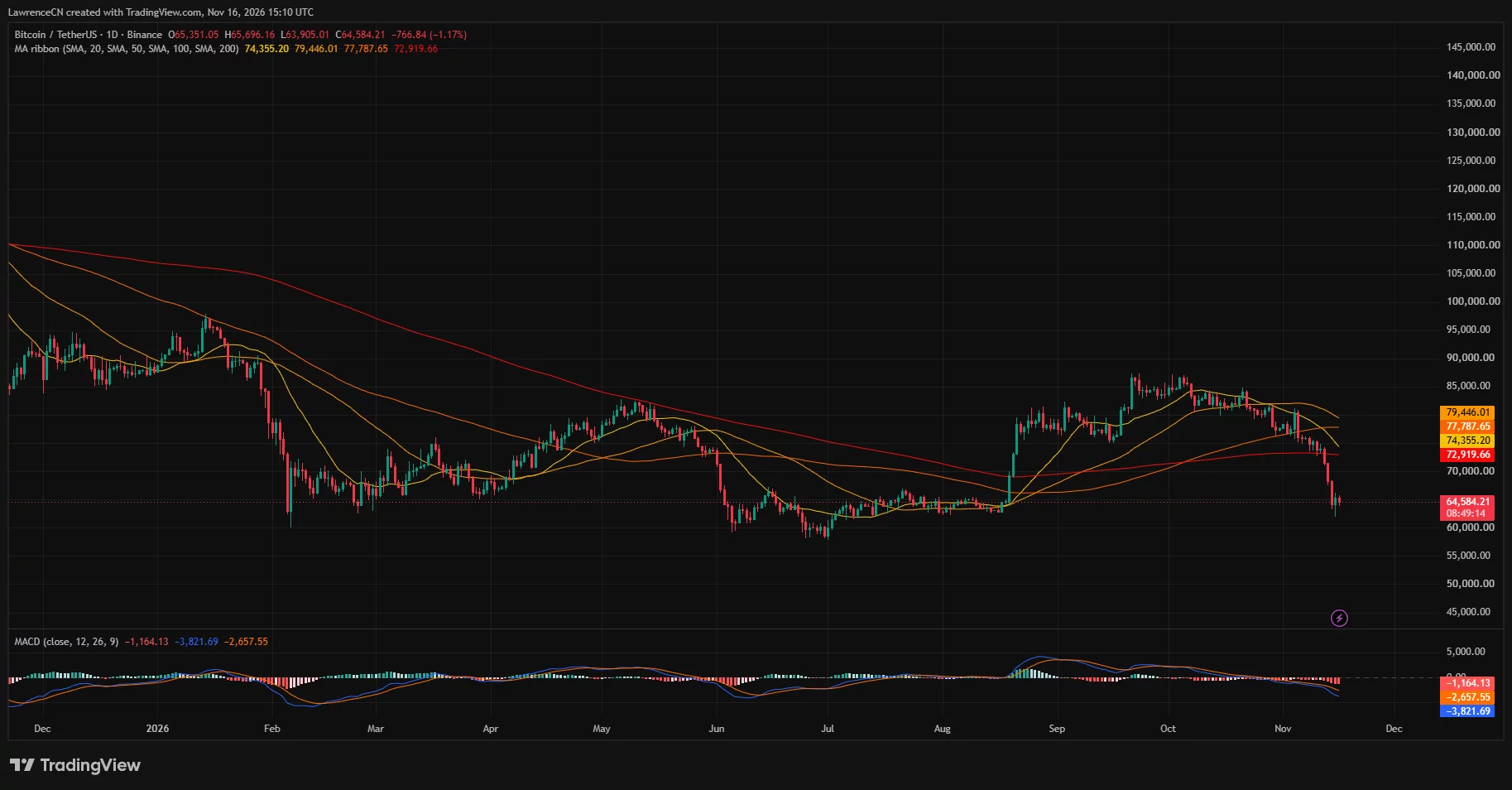
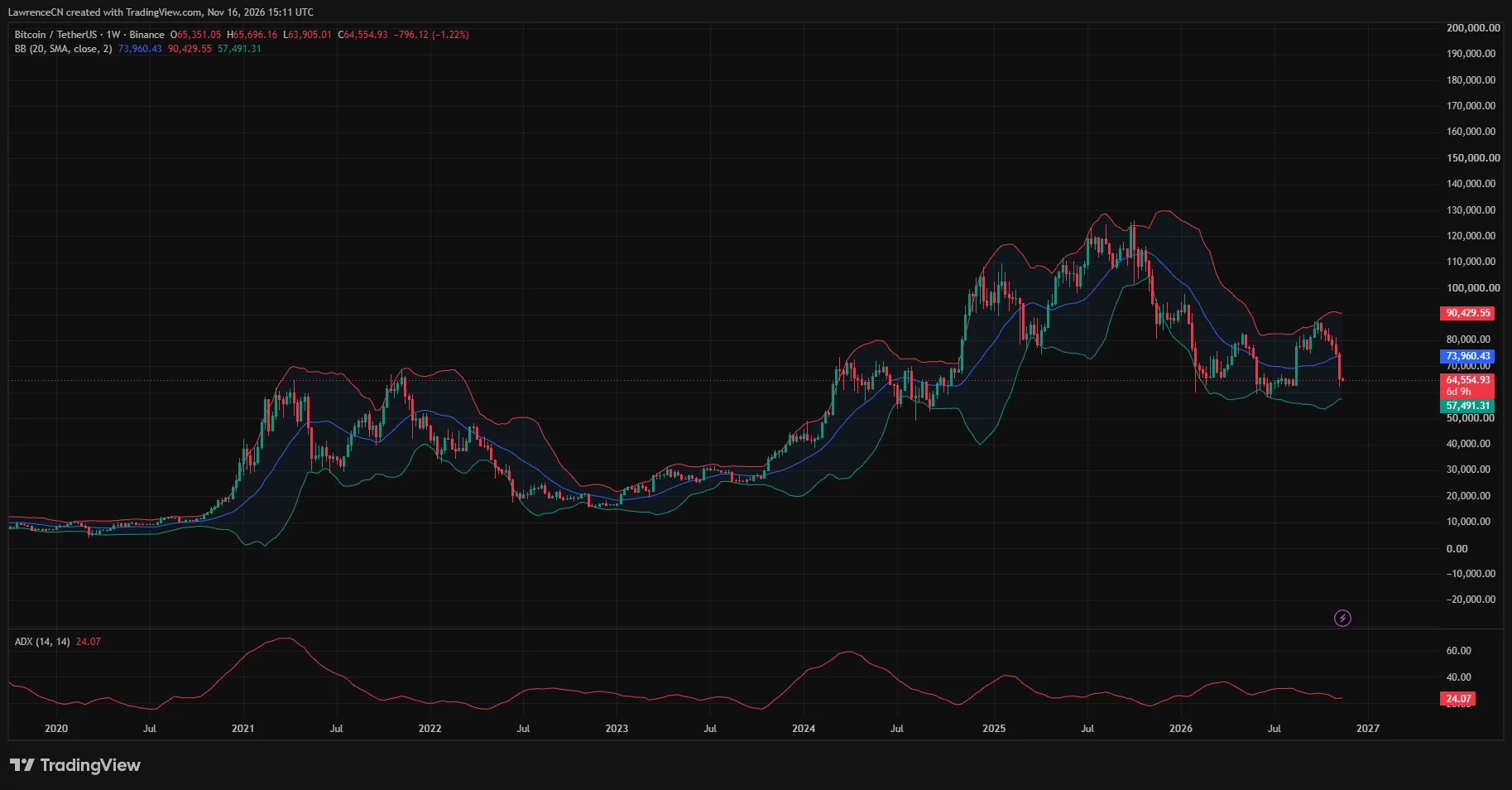
Daily MACD remains below its signal line and zero, with a negative histogram. On the weekly chart, Bitcoin trades below the Bollinger Band midpoint around $73,960, while the lower band stands near $57,491.
CryptoBullet, in the Nov. 16 post, described daily RSI as deeply oversold and suggested Bitcoin could consolidate for one or two months. He identified the 200-day moving average as a key level.
A separate market recovery assessment cited KuCoin identifying $62,000–$63,000 as immediate support and $67,000–$70,000 as a recovery zone Bitcoin would need to reclaim.
Traders map $63,900 and $65,400 as immediate triggers
Merlijn The Trader outlined two conditional scenarios in his post: a break above $65,400 would put $68,000 in focus, while losing $63,900 would point toward $61,000.
Someone's getting liquidated today. I'm making sure it's not me.$BTC is trapped between $63.9K and $65.4K.
— Merlijn The Trader (@MerlijnTrader) November 16, 2026
Liquidity is stacked above and below.
Break $65.4K: I'm long.
Target: $68K. Where the shorts start covering.
Lose $63.9K: I flip short.
Target: $61K. Where the late… pic.twitter.com/PzmbiFVvpL
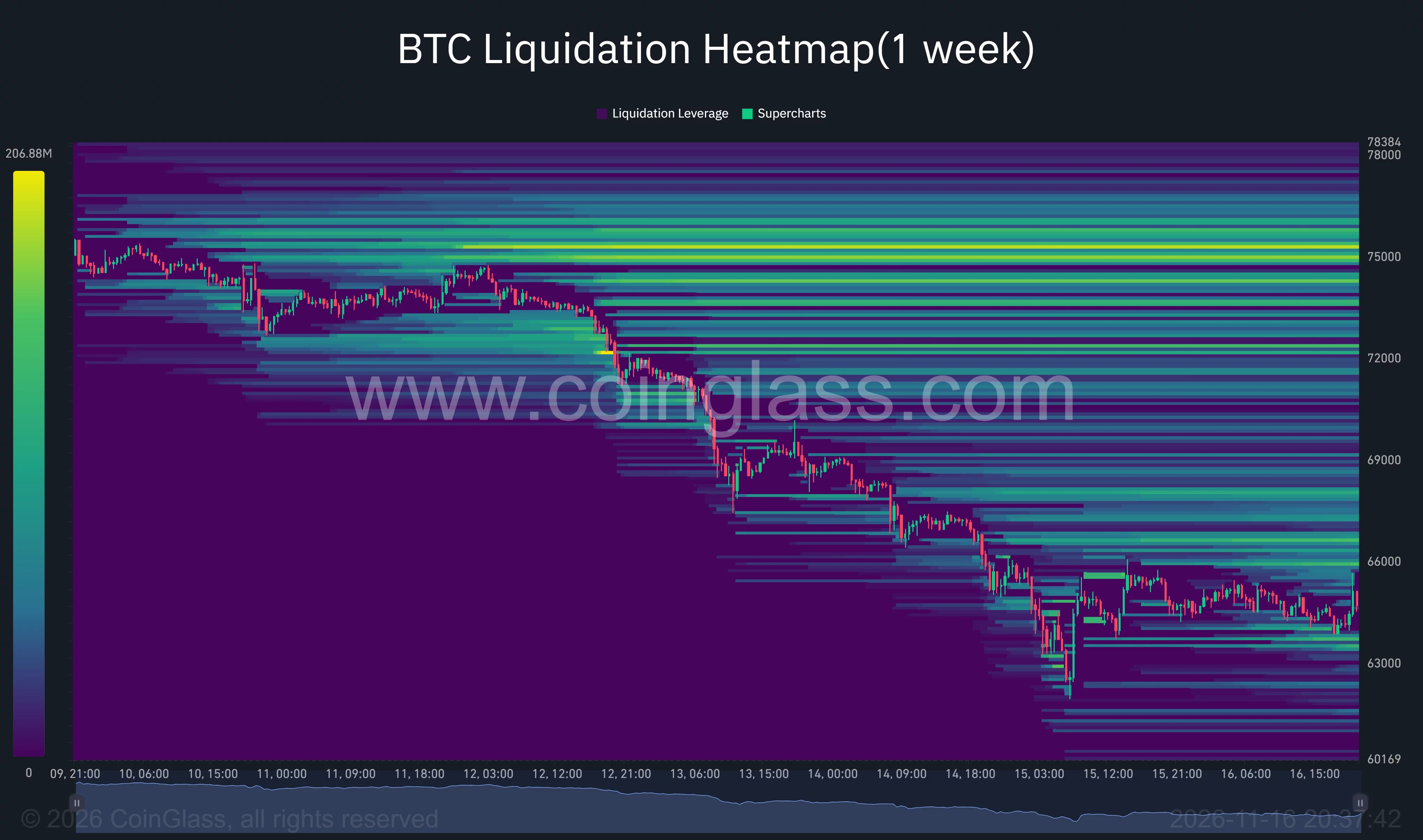
The CoinGlass heatmap shows nearby estimated liquidation concentrations around $63,500–$64,000 below price and $65,500–$66,000 above it, with further overhead bands toward $68,000–$69,000.
Marre said options positioning remained defensive after implied volatility eased from its spike. His figures put one-week realized volatility at 59%, compared with implied volatility of 47%, and 10-delta skew at 17 points in favor of puts.
Disclosure: This article does not represent investment advice. The content and materials featured on this page are for educational purposes only.
Read more: Cosmos Labs and Peersyst explore Honduras CBDC and instant paymentsUS crypto regulation hub
Crypto mining in the US: federal rules and the state map
Crypto kiosk rules by state: bans, licenses and the fraud data
Crypto ETF rules in the US: how a fund gets listed now
Crypto banking access in the US: master accounts, the chokepoint, and what changed
CFTC and crypto in 2026: what the agency now governs
Is crypto legal in the US? Yes, and here is the structure
Crypto executive orders: what the White House has actually ordered
SEC crypto enforcement in 2026: from registration war to fraud beat
IRS crypto tax rules in 2026: what actually gets taxed
The OCC and crypto: national trust charters, explained
View allDeep Dives
 Feature
Read more - Ondo stock-backed loans charge no interest. Borrowers give up upside
Ondo stock-backed loans charge no interest. Borrowers give up upside
 ONDO
Ondo
5 hours ago
 Feature
Read more - Trezor found implants in reseller wallets. What protects the buyer?
Trezor found implants in reseller wallets. What protects the buyer?
5 hours ago Feature
Read more - Ethereum staking ETFs pay different rewards for holding the same asset
Ethereum staking ETFs pay different rewards for holding the same asset
 ETH
Ethereum
6 hours ago
 Feature
Read more - The CLARITY Act faces a January reset. Can lawmakers avoid it?
The CLARITY Act faces a January reset. Can lawmakers avoid it?
6 hours ago Feature
Read more - XRP price prediction after the $1 break. Is $0.80 back in play?
XRP price prediction after the $1 break. Is $0.80 back in play?
 XRP
XRP
1 day ago
 Feature
Read more - Pi Network price prediction as PI loses $0.07 before November summit
Pi Network price prediction as PI loses $0.07 before November summit
 PI
Pi Network
2 days ago
 Recap
Read more - Bitcoin breaks $70K, Coinbase gets charter, NYSE picks Avalanche | Weekly recap
Bitcoin breaks $70K, Coinbase gets charter, NYSE picks Avalanche | Weekly recap
2 days ago Feature
Read more - Nvidia faces scrutiny over China. What about the Trump family’s UAE crypto ties?
Nvidia faces scrutiny over China. What about the Trump family’s UAE crypto ties?
3 days ago Feature
Read more - Wall Street wants crypto’s perpetual futures. The fight is over the rules
Wall Street wants crypto’s perpetual futures. The fight is over the rules
3 days ago Feature
Read more - Ethereum made transactions cheaper. Where does that leave ETH?
Ethereum made transactions cheaper. Where does that leave ETH?
ETH
Ethereum
3 days ago