

 The payment rail for your crypto. One card. Every chain. No KYC. Spend with Apple Pay or Google Pay in 180+ countries.
Bitcoin’s Coinbase Premium Index has stayed below zero for 51 consecutive days, with the latest reading at −0.10% as the US exchange continues to price BTC below Binance.
Summary- 51 consecutive days of negative Coinbase premiums date back to Sept. 23, according to CoinGlass.
- The latest −0.10% reading is less negative than the dashboard’s 30-day average of −0.14%.
- US Bitcoin ETF withdrawals and analysts’ demand concerns provide separate evidence of cautious buying.
- A negative exchange premium alone does not establish that institutional investors are withdrawing funds.
According to CoinGlass data, the negative run began on Sept. 23, with its dashboard showing an annual average premium of −0.06%. Both the latest reading and the monthly average sit below that annual figure.
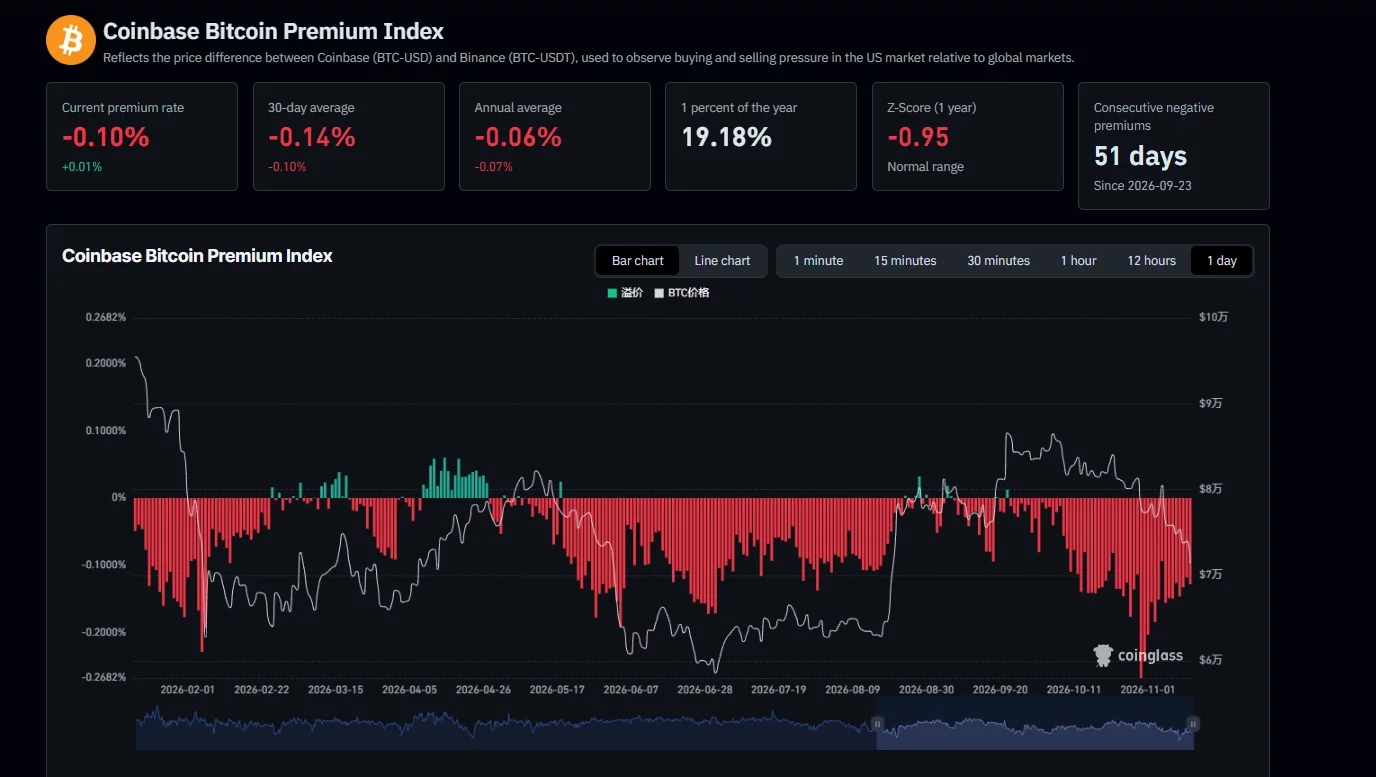
The index compares Bitcoin’s price on Coinbase’s BTC-USD market with its price on Binance’s BTC-USDT market. CoinGlass describes the measure as a way to observe buying and selling pressure in the US market relative to global markets.
Bitcoin’s discount persists despite a smaller latest gap
At −0.10%, the latest premium is 0.04 percentage points above the 30-day average of −0.14%, calculated from the dashboard figures. Bitcoin therefore remains cheaper on Coinbase in the comparison, although the current discount is smaller than the average recorded over the past month.
Compared with the annual average of −0.06%, the latest reading is 0.04 percentage points lower. The monthly average is 0.08 percentage points below the annual figure, placing the recent period further into negative territory than the longer reference window.
You might also like: Bitcoin Core reveals Tor flaw that trusted thousands of nodesCoinGlass’s one-year Z-score stands at −0.95, which the dashboard labels within its normal range. The negative premium streak and the statistical reading describe different features of the data: one counts consecutive negative days, while the other measures the reading against its historical distribution.
Neither the percentage discount nor the duration identifies the buyers and sellers behind individual transactions. The measure records a price difference between two markets, without providing a dollar total for money entering or leaving institutional portfolios.
US Bitcoin ETFs record separate withdrawals
US investment products have reported withdrawals during the same period. As crypto.news previously reported, spot Bitcoin ETFs recorded five consecutive outflow sessions through Nov. 11, losing roughly $1.44 billion across that stretch.
SoSoValue figures cited in the coverage put Nov. 11 net withdrawals at $299.9 million. BlackRock’s iShares Bitcoin Trust accounted for $269.73 million, while Grayscale’s Bitcoin Trust lost $39.13 million.
Morgan Stanley’s Bitcoin Trust attracted $8.96 million, partially offsetting the withdrawals from those two funds. The remaining products recorded no net movement during the session, according to the same dataset.
Despite the recent outflows, cumulative net inflows since the funds launched in January 2024 stood at $55.1 billion in that report. Combined net assets totaled $93.7 billion, with BlackRock’s fund holding $58.71 billion.
ETF subscriptions and redemptions measure activity in investment products. The Coinbase premium measures relative exchange pricing; neither dataset specifies the identity or motivation of every investor involved.
Bitfinex points to weak spot buying and persistent leverage
In a Nov. 11 assessment, Bitfinex analysts described weak spot buying alongside futures positions that continued growing while Bitcoin fell. Their figures put futures open interest at 701,900 BTC, up 3.3% between Nov. 8 and Nov. 11, while the price declined 2.6%.
Following the US inflation release, open interest fell just 0.2% despite approximately $729 million in liquidations. Bitfinex interpreted the limited change as evidence that traders were replacing closed positions almost immediately.
The analysts identified $75,717 as the average purchase price of coins held for fewer than 155 days. They estimated that 1.6 million BTC purchased between $75,000 and $80,000 was underwater, leaving recent buyers exposed to losses.
In their assessment, holders could sell into rallies approaching their purchase prices until fresh spot demand returns.
Options investors continue paying for protection
Earlier comments on buying demand from Bitget Wallet Research tied a sustained recovery to positive ETF flows and more balanced derivatives positioning. The analysts said the selloff had removed some speculative excess, while fresh demand remained insufficient.
CoinShares managing director Marc des Ligneris described continued defensive positioning in separate comments published Nov. 10. His assessment focused on one-month options skew, using a convention in which positive readings indicate investors paying more for downside protection through puts than for upside exposure through calls.
“This time it hasn’t held so far: skew has risen again, showing that investors are still paying up to hedge,” des Ligneris said.
Read more: Robinhood crypto volume falls 21% as event contracts hit 5.9BUS crypto regulation hub
Crypto mining in the US: federal rules and the state map
Crypto kiosk rules by state: bans, licenses and the fraud data
Crypto ETF rules in the US: how a fund gets listed now
Crypto banking access in the US: master accounts, the chokepoint, and what changed
CFTC and crypto in 2026: what the agency now governs
Is crypto legal in the US? Yes, and here is the structure
Crypto executive orders: what the White House has actually ordered
SEC crypto enforcement in 2026: from registration war to fraud beat
IRS crypto tax rules in 2026: what actually gets taxed
The OCC and crypto: national trust charters, explained
View allDeep Dives
 Feature
Read more - Nvidia faces scrutiny over China. What about the Trump family’s UAE crypto ties?
Nvidia faces scrutiny over China. What about the Trump family’s UAE crypto ties?
5 hours ago Feature
Read more - Wall Street wants crypto’s perpetual futures. The fight is over the rules
Wall Street wants crypto’s perpetual futures. The fight is over the rules
9 hours ago Feature
Read more - Ethereum made transactions cheaper. Where does that leave ETH?
Ethereum made transactions cheaper. Where does that leave ETH?
 ETH
Ethereum
9 hours ago
 Feature
Read more - Bitcoin holders are selling to pay the bills. MARA shows why
Bitcoin holders are selling to pay the bills. MARA shows why
 BTC
Bitcoin
10 hours ago
 News
Read more - Exclusive: Canton Strategic CEO warns MEV could raise costs for tokenized stock traders
Exclusive: Canton Strategic CEO warns MEV could raise costs for tokenized stock traders
10 hours ago Feature
Read more - The crypto developer who passes the interview and becomes the security threat
The crypto developer who passes the interview and becomes the security threat
1 day ago Feature
Read more - Inside XRP Ledger’s lending plan, where the borrower posts no collateral
Inside XRP Ledger’s lending plan, where the borrower posts no collateral
 XRP
XRP
1 day ago
 Feature
Read more - Strategy faces MSCI’s exit. Does that put its Bitcoin buying at risk?
Strategy faces MSCI’s exit. Does that put its Bitcoin buying at risk?
BTC
Bitcoin
1 day ago
 Feature
Read more - Nvidia’s Jensen Huang crisis reaches crypto through more than Bitcoin
Nvidia’s Jensen Huang crisis reaches crypto through more than Bitcoin
BTC
Bitcoin
1 day ago
 Feature
Read more - From tokenized shares to usable collateral inside DTCC’s new service
From tokenized shares to usable collateral inside DTCC’s new service
2 days ago News
Read more - Crypto market sees brief relief after cooler US PPI data
Crypto market sees brief relief after cooler US PPI data
3 hours ago Markets
Read more - Bitcoin price falls 4%, can BTC recover above $70,000?
Bitcoin price falls 4%, can BTC recover above $70,000?
BTC
Bitcoin
3 hours ago
 Markets
Read more - Bitcoin price bottom at $68K? Analyst points to historic support
Bitcoin price bottom at $68K? Analyst points to historic support
BTC
Bitcoin
7 hours ago