

 The payment rail for your crypto. One card. Every chain. No KYC. Spend with Apple Pay or Google Pay in 180+ countries.
Initia has halted its layer-1 blockchain for the second time in less than three weeks after attackers used compromised rollup infrastructure keys to carry out unauthorized transfers, while its native INIT token gained more than 60%.
Summary- Initia halted its layer-1 blockchain at 06:18 UTC on November 10 following unauthorized escrow transfers.
- Compromised rollup infrastructure keys allegedly enabled attackers to fabricate IBC transfers from affected escrow accounts.
- Initia reported approximately $615,000 in unauthorized transfers, while CertiK identified roughly $636,000 across 16 transactions.
- INIT gained 61.31% over 24 hours, with trading volume reaching approximately $84.81 million, CoinGecko reported.
- The November incident followed an October 23 exploit involving approximately $2.7 million in unauthorized transfers.
According to a November 10 announcement, the network stopped producing blocks at 06:18 UTC after the team coordinated with validators to prevent further unauthorized transfers. Its preliminary investigation found that attackers had accessed escrow accounts containing assets bridged between Initia’s main blockchain and its connected rollups.
The Initia L1 was halted at 06:18 UTC on November 10 in coordination with validators as a protective measure.
— Initia (@initia) November 10, 2026
We took this step after identifying unauthorized transfers from the escrow accounts on the Initia L1 that hold assets bridged to several rollups. Our investigation so…
Before the halt, approximately $605,000 in USDC and another $10,000 in other tokens had left the network through Noble. Initia said most of the remaining assets transferred from the affected escrow accounts were still on its halted blockchain.
You might also like: Initia halts blockchain and rollups after reported $2.6M exploitInitia confirms compromised rollup keys behind $615K exploit
In its security update, Initia explained that the attacker used compromised rollup infrastructure keys to fabricate Inter-Blockchain Communication (IBC) transfers, allowing assets to move without proper authorization.
The affected escrow accounts held assets associated with several rollups operating within the Initia ecosystem. IBC enables connected blockchains to exchange information and transfer assets through established communication channels.
Although the team identified compromised infrastructure keys as the apparent attack method, it has not explained how those credentials were obtained or identified who controlled them before the incident.
Blockchain security firm CertiK reported detecting approximately $636,000 in suspicious outflows across 16 successful IBC transfers from an Initia address to the Noble blockchain.
The figure is higher than Initia’s preliminary estimate of approximately $615,000. Neither statement establishes the final amount of unrecoverable funds, as the investigation remains ongoing.
Initia said it was working with security specialists, validators and cryptocurrency exchanges to determine the incident’s full scope.
However, the team has not announced when block production will resume or whether affected users will receive reimbursement.
Initia suffers second blockchain halt since October exploit
The November incident follows another security breach that forced Initia to suspend its blockchain on October 23.
As crypto.news previously reported, the earlier shutdown followed unauthorized token creation and reports that approximately $2.6 million had been transferred out of the ecosystem.
In an October 24 statement, Initia confirmed that an attacker exploited a vulnerability in its MoveVM script-caching system.
The flaw allowed malicious code to bypass security checks and manipulate the blockchain’s internal state, crediting the attacker with unbacked WETH, iUSD and USDC balances.
According to the team, approximately $2.7 million was bridged out before validators halted the network. The assets included 105 WETH, approximately 1.4 million AUSD0 and roughly 1.08 million USDC.
The attacker subsequently exchanged the transferred assets for 1,135.52 ETH on Ethereum.
Initia said no native INIT tokens were minted during that attack, leaving the token’s total supply unchanged.
Following security work and a MoveVM patch, the project resumed operations on November 2.
On November 9, the team disclosed another issue affecting rollup infrastructure, saying it had coordinated temporary rollup pauses while the main blockchain remained operational.
“We have not identified any impact to user funds,” Initia stated at that stage.
The subsequent investigation identified the unauthorized escrow transfers, prompting the November 10 network shutdown.
INIT price rises over 60% during blockchain suspension
Initia’s native token recorded gains during the same period in which the blockchain experienced its second security-related suspension.
According to CoinGecko market data, INIT traded near $0.2057, representing a 61.31% increase over the previous 24 hours.
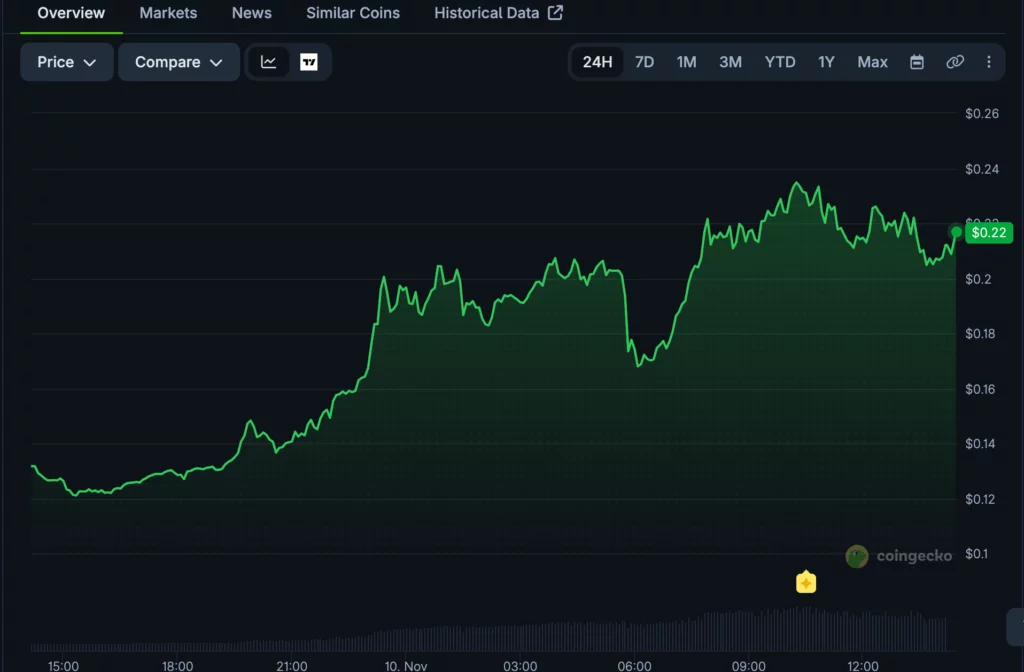
The token’s reported price moved from approximately $0.12 to above $0.23 during the trading period, although its value remained subject to market fluctuations.
Trading volume reached approximately $84.81 million over 24 hours, while INIT’s market capitalization stood near $46.37 million.
CoinGecko reported a circulating supply of approximately 220 million INIT tokens, with the cryptocurrency gaining 54.22% over the preceding seven days.
Initia investigates escrow transfers and recovery options
Following the suspension, Initia said it was coordinating with validators, security teams and exchanges to determine the full extent of the unauthorized transfers.
The preliminary findings identified compromised rollup infrastructure keys, but the team has not established publicly how the attacker obtained access to those credentials.
The announcement did not identify the compromised rollups or specify whether the affected infrastructure was operated directly by Initia or by separate parties.
It remains unclear how much of the transferred cryptocurrency can be recovered. The project said most assets removed from the escrow accounts remained on the halted layer-1 network.
Initia has not confirmed whether the November incident involved the same attacker responsible for the October exploit.
The team warned users against unofficial links, messages and recovery claims circulating during the investigation.
Read more: Crypto payouts for businesses: Fees, networks and how mass payments work 24h Volume $91,771,171 Market Cap $42,108,174 24h Low/High $0.121049 / $0.236083 24h 53.09% 7d 54.22%“We will share more details as they become available,” Initia said.
US crypto regulation hub
Crypto mining in the US: federal rules and the state map
Crypto kiosk rules by state: bans, licenses and the fraud data
Crypto ETF rules in the US: how a fund gets listed now
Crypto banking access in the US: master accounts, the chokepoint, and what changed
CFTC and crypto in 2026: what the agency now governs
Is crypto legal in the US? Yes, and here is the structure
Crypto executive orders: what the White House has actually ordered
SEC crypto enforcement in 2026: from registration war to fraud beat
IRS crypto tax rules in 2026: what actually gets taxed
The OCC and crypto: national trust charters, explained
View allDeep Dives
 Feature
Read more - The Bitcoin inheritance gap between a will and a wallet
The Bitcoin inheritance gap between a will and a wallet
 BTC
Bitcoin
4 hours ago
 Feature
Read more - Can you still withdraw from Base or Arbitrum if the sequencer goes down?
Can you still withdraw from Base or Arbitrum if the sequencer goes down?
4 hours ago Feature
Read more - Inside a Visa card payment that settles in USDC
Inside a Visa card payment that settles in USDC
4 hours ago Feature
Read more - How small deposits drained 77 ACryptoS vaults and what users can still withdraw
How small deposits drained 77 ACryptoS vaults and what users can still withdraw
1 day ago Feature
Read more - Ethereum put Glamsterdam’s Hoodi fork on hold. What did auditors find?
Ethereum put Glamsterdam’s Hoodi fork on hold. What did auditors find?
 ETH
Ethereum
1 day ago
 Feature
Read more - What happens to Solana validators that miss the Agave 4.4.1 upgrade?
What happens to Solana validators that miss the Agave 4.4.1 upgrade?
1 day ago Feature
Read more - Can crypto recover if US inflation keeps rate hike bets alive?
Can crypto recover if US inflation keeps rate hike bets alive?
1 day ago Feature
Read more - Why did the ED raid CoinDCX and Delta Exchange? What users should know
Why did the ED raid CoinDCX and Delta Exchange? What users should know
2 days ago Feature
Read more - Can companies stop third parties trading tokenized US shares?
Can companies stop third parties trading tokenized US shares?
3 days ago Recap
Read more - Binance recovery, US crypto bill talks, Bitcoin ETF exits | Weekly recap
Binance recovery, US crypto bill talks, Bitcoin ETF exits | Weekly recap
3 days ago News
Read more - NEAR AI fixes SGLang security flaw, restores Cloud service
NEAR AI fixes SGLang security flaw, restores Cloud service
5 hours ago News
Read more - Coldcard’s $116M exploit sparks fresh clash over NVK’s defense
Coldcard’s $116M exploit sparks fresh clash over NVK’s defense
17 hours ago News
Read more - China unifies blockchain and AI filings as two old systems close
China unifies blockchain and AI filings as two old systems close
21 hours ago