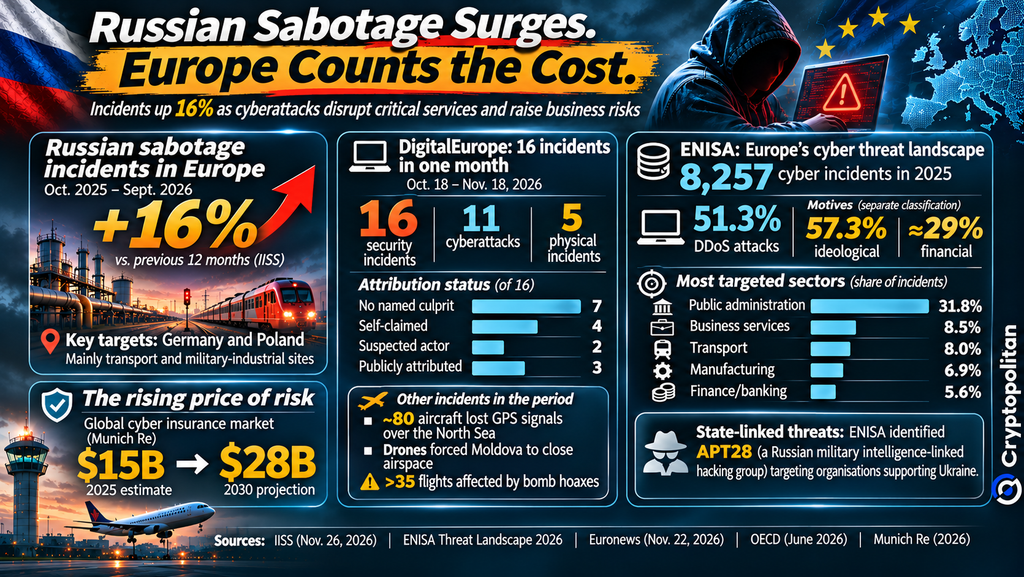
According to the International Institute for Strategic Studies (IISS) on November 26, incidents of Russian sabotage in Europe from October 2025 to September 2026 rose by 16%.
In addition to the threat of physical sabotage, there is a threat from cyberattacks on essential services that are increasing security expenses, and creating higher exposure to financial risks for businesses internationally.
A rise in sabotage as overall activity fell
According to the IISS, the number of incidents involving Russian sabotage increased even though the overall hostile activity in Europe decreased. The think tank refers to sabotage as acts that result in damages to property, infrastructure, or data on behalf of a foreign power. Hostile activity, on the other hand, also covers intelligence gathering, assassination attempts, and persecution of individuals.
From October 2025 to September 2026, the amount of overall hostile activity recorded dropped by about 13% when compared to the year before. Reconnaissance activities, involving intelligence gathering, dropped by nearly half. On the other hand, the use of arson and explosives went up almost 100%.
The selection of targets provides clues about the likely goals of the campaign launched by Russia. Military facilities and defence installations were targeted in 28% of incidents, followed by the transport industry (22%) and energy sector (7%). These industries are all critical for supporting the provision of assistance from European countries to Ukraine.
Their strategic importance helps explain why Germany and Poland remain the most frequently targeted countries. Both play central roles in supplying Ukraine with military equipment. Protecting these supply networks is also becoming more challenging as some Russian operatives grow more skilled, the IISS warned.
Moscow, however, has rejected Western accusations of a sabotage campaign.
Cyber threats beyond Russia’s sabotage campaign
The IISS figures provide a limited view of Europe’s security threats. The think tank usually leaves out cyberattacks from the sabotage count, unless the attacks result in damage to physical infrastructure.
A broader assessment by DigitalEurope, a European technology industry association, shows the magnitude of these security threats. The association documented 16 security incidents across Europe from October 18 to November 18, 2026. These incidents include 11 cyberattacks and five physical security incidents.
The physical security incidents brought to light weaknesses in European aviation. About 80 aircraft lost GPS signals while flying over the North Sea, drones forced Moldova to close its airspace, and a bomb scare affected more than 35 flights.
Meanwhile, cyberattacks disrupted essential services across several industries. A German hospital closed its emergency room, a Norwegian energy company lost access to its IT systems, and a French bank lost approximately €100 million through a compromised supplier.
The disruptions across different industries show why cybersecurity needs to be treated as an economic and national security priority, rather than just an IT concern.
Default passwords and no one to blame
The vulnerability of essential services became particularly apparent on November 2 and 3, 2026. Cyberattacks disrupted supermarket refrigeration across several European countries and affected French blood banks.
The attacks followed similar incidents involving around 350 French supermarkets in mid-October 2026. Cybersecurity company Forescout identified nearly 13,000 refrigeration control systems exposed to the internet across 99 countries. Some still used default passwords, making them easier to compromise.
However, identifying the perpetrators continues to be a difficult task. Of DigitalEurope’s 16 recorded incidents, only three were publicly attributed to specific actors. Authorities cannot establish with certainty if the other incidents formed part of Russia’s sabotage campaign.
Determining who is responsible is further complicated by the different motives behind cyberattacks. Of the 8,257 incidents analysed by the European Union Agency for Cybersecurity (ENISA) in its 2026 report, 57.3% were driven by ideology and around 29% by financial gain. Even when attacks are politically motivated, they are not necessarily state-sponsored.
The bill lands on businesses
Regardless of who carries out the attacks, businesses face the cost of preventing disruptions and restoring operations. Sabotage can be relatively inexpensive to conduct, but defending against it can be costly.
Those expenses are not limited to the companies directly targeted. The Organisation for Economic Co-operation and Development (OECD) warns that attacks on suppliers and shared technology providers can spread financial losses across interconnected global markets.
European financial regulators have raised similar concerns. As Cryptopolitan previously reported, Europe’s heavy reliance on non-EU providers, infrastructure and currencies could amplify the impact of geopolitical shocks and cyberattacks.
Growing exposure to cyber risks also has implications for the insurance industry. Reinsurer Munich Re estimates that the global cyber insurance market could grow from nearly $15 billion in 2025 to around $28 billion by 2030.
If you're reading this, you’re already ahead. Stay there with our newsletter.