

 The payment rail for your crypto. One card. Every chain. No KYC. Spend with Apple Pay or Google Pay in 180+ countries.
Disclosure: This article does not represent investment advice. The content and materials featured on this page are for educational purposes only.
Bitcoin wallets have traditionally been created to buy, store, send, and receive Bitcoin. However, evolving user expectations are transforming them into apps for broader financial activities. Modern wallets are increasingly integrating payments, asset swaps, buys, transfers, and multi-asset management in one place.
Wallets such as Speed Wallet reflect this shift by bringing Bitcoin, Stablecoins, Lightning payments, and other financial features together. This evolution signals a move from simply holding digital assets to actively using them.
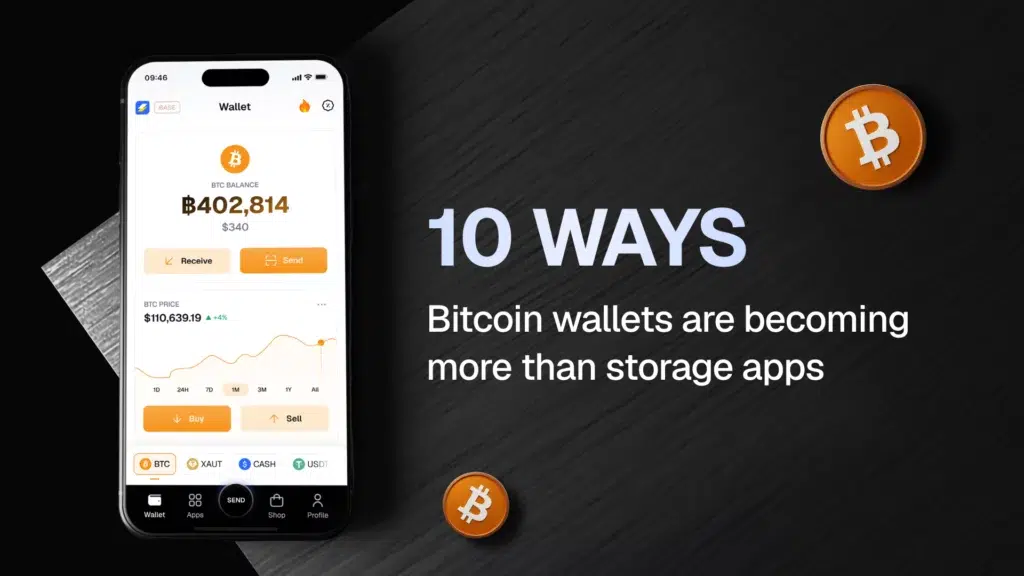
10 ways Bitcoin wallets are expanding their utility
1. Enabling everyday Bitcoin payments
Bitcoin wallets are increasingly becoming practical payment infrastructure. Instead of limiting Bitcoin to long-term holdings, users can use supported wallets such as Speed Wallet to pay for things and services wherever Bitcoin payments are accepted.
Lightning Network integration has further expanded this possibility. It enables faster quicker transactions, making smaller everyday payments more practical. With QR codes and simplified payment interfaces, wallets are making it easier to use Bitcoin beyond investment purposes.
2. Making Bitcoin buying more accessible
Earlier, buying Bitcoin often required users to navigate separate apps or trading platforms before transferring their assets to a wallet. Modern wallets are integrating buying capabilities directly into their ui’s.
Users can buy Bitcoin using supported payment methods, including bank transfers and payment cards, depending on their location and eligibility. This reduces the number of steps between adding funds to an account and owning Bitcoin. Integrated buying features also make wallets more accessible to beginners who want a simpler way to enter the Bitcoin ecosystem.
3. Supporting instant payments through lightning
Speed is an important factor in considering Bitcoin useful for everyday activities. While on-chain transactions remain necessary for Bitcoin transfers and settlement, the Lightning Network provides another method to transact. Lightning-enabled wallets support faster payments, often with lower transaction costs.
Features such as Lightning Addresses also simplify receiving Bitcoin by allowing users to share an easy-to-remember address instead of a lengthy payment string. This makes sending and receiving smaller amounts of Bitcoin more convenient and feasible for everyday transactions.
4. Bringing multiple digital assets together
Bitcoin is no longer the only digital asset users want to manage. Stablecoins such as USDT and USDC offer dollar-based digital value, while tokenized assets such as gold-backed tokens provide access to other asset categories of assets as well..
Multi-asset wallets bring these alternatives together in one app. Rather than maintaining separate wallets for different assets, users can access supported balances and manage their holdings through a single wallet interface. This approach makes digital asset management more easy while giving users greater flexibility in how they use their funds.
5. Enabling in-app asset swaps
Swapping is another feature expanding the role of Bitcoin wallets. Users may want to exchange Bitcoin for Stablecoins, move between supported assets, or access a different digital asset without navigating an external platform.
An integrated swap function makes this possible within the wallet itself. For example, in Speed Wallet users can select the asset they have, choose the asset they want to receive, review the amount and applicable fees, and confirm the transaction. This reduces the need to transfer assets between multiple wallets and makes managing different digital currencies more straightforward.
6. Simplifying domestic and cross-border transfers
Digital wallets are making it easier to transfer value between individuals across different geographies. Traditional international transfers involve multiple intermediaries, processing delays, and currency conversion steps. Bitcoin and Lightning-enabled wallets offer alternative methods to transfer digital value across supported networks.
Users can send funds using wallet addresses, QR codes, or Lightning payment details. However, transaction fees, network compatibility, recipient access, and applicable regulations remain important considerations. The broader development is that wallets are becoming more versatile tools for moving digital assets between people and locations.
7. Automating Bitcoin buys
Modern wallets are also introducing features that help users manage their Bitcoin buying habits more consistently. Recurring Bitcoin buys allow users to schedule Bitcoin buys at regular intervals rather than initiating every transaction manually.
This supports a dollar-cost averaging approach, where users buy fixed amounts over time instead of relying on a single market entry point. By integrating scheduled purchases, wallets are evolving from transactional apps into platforms that support ongoing asset management.
8. Connecting users with different financial networks
The utility of a wallet also depends on how easily it connects with different payment networks and blockchain ecosystems. Modern wallets increasingly support multiple networks, allowing users to send and receive supported assets through compatible transaction routes.
For example, Bitcoin can be transferred through on-chain and Lightning networks, while Stablecoins may operate across networks such as Ethereum and Tron. This flexibility gives users more ways to manage and transfer their digital assets. However, selecting the correct network remains essential to avoid failed or incorrectly routed transactions.
9. Making asset management more convenient
As users hold different digital assets, monitoring & keeping track of balances, transactions, and market movements becomes increasingly necessary. Wallets are incorporating features such as transaction histories, balance overviews, and price alerts.
These features help users monitor their holdings without relying on multiple apps. Some wallets like Speed Wallet also support recurring transactions and other automated features, making everyday asset management more organized.
10. Bringing more financial services into one app
The next stage of wallet evolution is the integration of additional features within a single application. Instead of using separate platforms for buying, transferring, swapping, and managing digital assets, users can access several features through one interface. This approach is often associated with the financial super app model.
Its purpose is not simply to increase the number of available features but to create a connected experience that reduces unnecessary app switching. For this model to succeed, wallets must balance convenience with security, transparent fees, reliable infrastructure, and an intuitive user experience.
What should users look for in a modern Bitcoin wallet?
As Bitcoin wallets continue to expand their features, choosing one requires looking beyond basic storage capabilities. Important considerations include:
- Security: Check account protection, backup options, recovery processes, and custody arrangements.
- Supported assets: Verify whether the wallet supports Bitcoin, stablecoins, and other assets like Tether gold (XAUT) you intend to use.
- Network compatibility: Look for support for relevant networks, including Bitcoin on-chain and Lightning.
- Transaction transparency: Review applicable network fees, swap rates, and purchase charges before confirming transactions.
- Ease of use: Choose an interface that makes buying, sending, receiving, and managing assets straightforward.
- Availability: Check whether specific services and payment methods are supported in your country.
A wallet with more features is not automatically a better wallet. Its usefulness ultimately depends on how securely and reliably those features meet individual requirements.
The future of Bitcoin wallets
Bitcoin wallets are evolving from basic storage apps into broader digital financial wallets. Payments, integrated buying, asset swaps, multi-asset support, and automated purchases are expanding how people interact with Bitcoin and other digital assets.
As these capabilities become more connected, wallets could play a greater role in everyday financial activities. The focus is shifting from simply owning Bitcoin to having more practical ways to access, manage, and use it.
Explore Speed Wallet to see how a modern digital wallet brings Bitcoin, Stablecoins, payments, transfers, and asset management together.
You might also like: Coinbase CEO says investors sell Bitcoin for major IPOs before returning to BTCDisclosure: This content is provided by a third party. Neither crypto.news nor the author of this article endorses any product mentioned on this page. Users should conduct their own research before taking any action related to the company.
24h Volume $72,465,350,175 Market Cap $1,215,453,281,192 24h Low/High $55,298.00 / $62,087.00 24h -1.5% 7d -12.53%US crypto regulation hub
Crypto mining in the US: federal rules and the state map
Crypto kiosk rules by state: bans, licenses and the fraud data
Crypto ETF rules in the US: how a fund gets listed now
Crypto banking access in the US: master accounts, the chokepoint, and what changed
CFTC and crypto in 2026: what the agency now governs
Is crypto legal in the US? Yes, and here is the structure
Crypto executive orders: what the White House has actually ordered
SEC crypto enforcement in 2026: from registration war to fraud beat
IRS crypto tax rules in 2026: what actually gets taxed
The OCC and crypto: national trust charters, explained
View allDeep Dives
 Feature
Read more - What CleanSpark’s $6.6 billion lease changes for its Bitcoin business
What CleanSpark’s $6.6 billion lease changes for its Bitcoin business
39 minutes ago Feature
Read more - Inside SBI and SMBC’s plan to put Japanese finance on Solana
Inside SBI and SMBC’s plan to put Japanese finance on Solana
 SOL
Solana
1 hour ago
 Feature
Read more - Where does Bitcoin price discovery move when Wall Street closes?
Where does Bitcoin price discovery move when Wall Street closes?
 BTC
Bitcoin
2 hours ago
 Feature
Read more - The limits of the SEC’s no-action letter for Molecule’s research tokens
The limits of the SEC’s no-action letter for Molecule’s research tokens
23 hours ago Feature
Read more - From stablecoin to fund share inside BlackRock’s Hong Kong cash fund
From stablecoin to fund share inside BlackRock’s Hong Kong cash fund
23 hours ago Feature
Read more - South Korea’s crypto bill could redraw who controls its exchanges
South Korea’s crypto bill could redraw who controls its exchanges
1 day ago Feature
Read more - After Monad’s 16.6 billion MON unlock, how much reached the market?
After Monad’s 16.6 billion MON unlock, how much reached the market?
1 day ago Interviews
Read more - Can Bitcoin compete with physical gold? Galantas Gold CEO weighs in
Can Bitcoin compete with physical gold? Galantas Gold CEO weighs in
BTC
Bitcoin
2 days ago
 Feature
Read more - What did Nvidia’s short-lived rally reveal about Bitcoin demand?
What did Nvidia’s short-lived rally reveal about Bitcoin demand?
2 days ago Feature
Read more - Where can Bitcoin count toward a US exchange’s operating reserves?
Where can Bitcoin count toward a US exchange’s operating reserves?
BTC
Bitcoin
2 days ago
 Feature
Read more - Trezor found implants in reseller wallets. What protects the buyer?
Trezor found implants in reseller wallets. What protects the buyer?
1 week ago
Feature
Read more - The Bitcoin inheritance gap between a will and a wallet The Bitcoin inheritance gap between a will and a wallet
BTC
Bitcoin
Nov 10, 2026 at 8:27 AM UTC
 News
Read more - Crypto firms turn to Anthropic AI to find security flaws