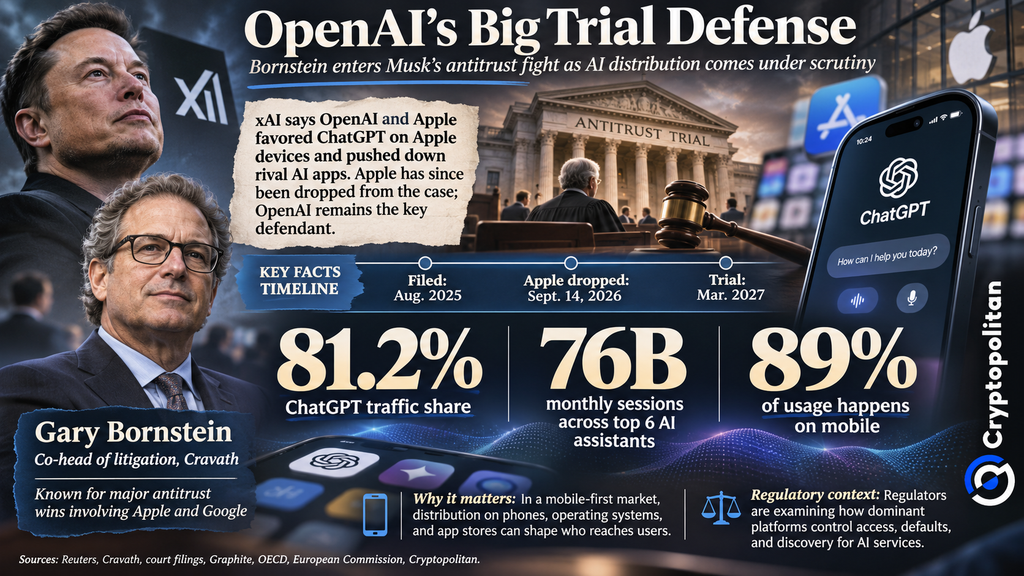
OpenAI has hired Gary Bornstein, co-head of litigation at Cravath, Swaine & Moore, to defend the company against Elon Musk’s xAI. The antitrust trial is scheduled for March 2027 in Fort Worth, Texas.
At the heart of the dispute is how technology companies compete in the global artificial intelligence (AI) market. Building better AI models may not be enough if competitors enjoy preferential access to smartphone users through operating systems and app stores.
A lawyer who already beat Apple in court
Bornstein is experienced when it comes to facing legal actions by Big Tech companies. As stated in his Cravath profile, he has represented Epic Games, the company that developed Fortnite in two different antitrust cases against Apple and Google.
He won a unanimous jury verdict against Google and secured a permanent injunction against Apple’s restrictions on directing customers to alternative payment options. He later secured a ruling holding Apple in civil contempt. Federal appeals courts later upheld those decisions.
OpenAI has now hired a lawyer who successfully challenged Apple’s business practices to defend its own partnership with the iPhone maker.
What Musk’s xAI says Apple and OpenAI did
As Cryptopolitan previously reported, X Corp. and xAI sued Apple and OpenAI in August 2025. Musk’s companies accused Apple of giving ChatGPT preferential treatment across its devices while putting competing chatbots, including Grok, at a disadvantage in its App Store.
The antitrust case is different from Musk’s case against OpenAI for not following through on its founding mission. That case ended with a jury verdict against Musk in May 2026.
Apple’s exit and OpenAI’s underperformance claim
On September 14, 2026, Judge Mark T. Pittman accepted the request from X Corp. and xAI for dismissal of the claims it had against Apple. The companies had reached an undisclosed settlement with Apple.
Eight days later, OpenAI submitted a brief for its summary judgment seeking a ruling without trial. OpenAI claimed that the partnership with Apple was nonexclusive and also the integration of ChatGPT drew less number of users than that was expected.
In OpenAI’s motion to dismiss filed in September of 2025, the company pointed out that there was a wait of more than nine months after the launch before any lawsuit was filed by Musk’s companies.
In a separate story, Apple has significantly increased its partnerships in the AI field. On January 12, 2026, Apple and Google announced a multiyear agreement to develop Apple’s next-generation AI models using Gemini technology.
ChatGPT’s 81% share and a mobile-first market
A November 9 Graphite study found that six leading AI assistants — ChatGPT, Gemini, Claude, Grok, Perplexity and DeepSeek — collectively recorded 76 billion sessions worldwide in September 2026. ChatGPT alone accounted for 81.2% of those sessions.
The study also examined how people access AI assistants. During the third quarter of 2026, 89% of recorded sessions across the six services occurred through mobile apps or mobile browsers. Desktop browsers accounted for the remaining 11%.
Graphite cautioned that the lack of reliable data on desktop applications means desktop usage is undercounted. Still, the findings help explain why partnerships with smartphone manufacturers and access to app stores are commercially important to AI companies.
Why regulators are watching distribution, not just models
Competition authorities are also examining how major technology companies control access to AI services.
A November 2026 OECD paper explores competition concerns surrounding agentic AI, or AI systems capable of carrying out tasks independently.
The OECD recognizes that integrating AI into existing services can make transactions easier and less costly. However, smaller AI developers could struggle to compete if platform owners restrict access to their users. Customers may also find it harder to switch AI providers. The paper points to investigations into restrictions on competing AI assistants’ access to WhatsApp.
European regulators have already taken action. On July 16, 2026, the European Commission issued binding measures requiring Google to give rival AI services equal access to Android features. Separate measures require Google to share certain search data with competing search engines.
What a ruling could change
The outcome of the Texas antitrust case could affect how technology companies structure AI partnerships worldwide.
Limited access to well-known digital platforms may mean that smaller AI vendors will need to pay more to get clients. Investors may also take a closer look at how much a company’s growth depends on partnerships they cannot easily acquire. The court’s ruling may help determine whether OpenAI has violated antitrust laws and where legitimate partnerships end and unlawful competition begins.
If you're reading this, you’re already ahead. Stay there with our newsletter.