
 The payment rail for your crypto. One card. Every chain. No KYC. Spend with Apple Pay or Google Pay in 180+ countries.
Injective has entered the U.S. exchange-traded fund market after Canary Capital launched its staked INJ ETF on Nasdaq, with the fund reaching $16.12 million in net assets during its first two trading sessions.
Summary- Canary Capital launched its staked Injective ETF on Nasdaq, giving investors access to INJ exposure.
- Injective CEO Eric Chen joined Canary Capital’s Steven McClurg for Nasdaq’s November 6 opening ceremony.
- INJC reported $16.12 million in assets by Friday, with 600,000 fund shares still outstanding overall.
- The fund seeks staking rewards through Injective validators, with net earnings reflected in asset value.
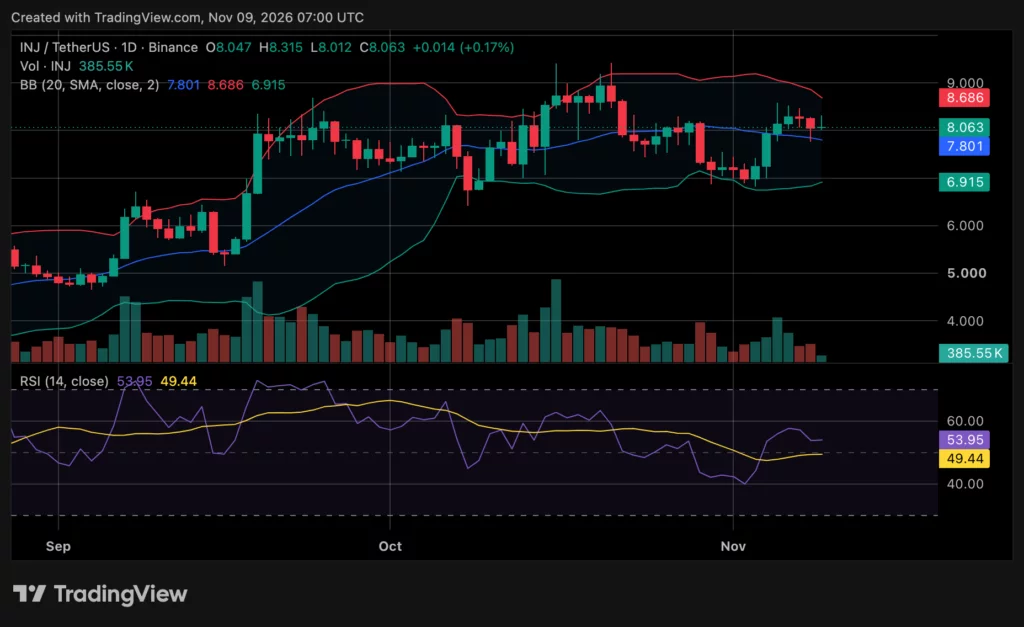
- Injective traded near $8.10 on November 9 after gaining more than 12% over seven days.
According to Nasdaq’s announcement, Injective Labs CEO Eric Chen joined Canary Capital CEO Steven McClurg to ring the opening bell on November 6, one day after the fund began trading under the ticker INJC. The ceremony followed the introduction of a product that combines direct exposure to Injective’s native cryptocurrency with participation in network staking.
Unlike a conventional spot cryptocurrency fund, INJC seeks to earn additional tokens through Injective’s proof-of-stake system. The rewards, after applicable costs, contribute to the fund’s net asset value instead of being paid directly to shareholders.
You might also like: Injective launches GPU rental index perpetuals with up to 10x leverageCanary’s INJ ETF starts trading with $16 million in assets
Canary announced that INJC began trading on Nasdaq on November 5, giving investors access to INJ through ordinary brokerage accounts.
The fund’s published records show it began with $15 million in net assets and 600,000 shares outstanding on November 4. By Thursday’s close, those assets had reached $15.64 million, while the share count remained unchanged.
Friday’s figures placed net assets at $16.12 million, with shares closing at $26.90, up $0.75 during the session. Trading volume reached 11,931 shares, and the closing price stood approximately 0.17% above the fund’s net asset value of $26.86.
The number of outstanding shares remained at 600,000 through November 6. Consequently, the increase in reported assets cannot be treated as evidence of new ETF subscriptions during the first two trading days.
Earlier, crypto.news covered Canary’s initial filing when the company established a Delaware trust for its proposed staked Injective product.
The subsequent amended registration statement outlined its proposed custody arrangements, token pricing benchmark and staking structure before the fund received its Nasdaq listing.
INJC stakes Injective tokens to earn additional rewards
Under the fund’s SEC filing, Canary expects to stake at least 90% of its INJ holdings under normal circumstances.
The sponsor can retain unstaked tokens to cover expenses, redemptions and other operational needs. Its published November 6 figures showed 100% of eligible holdings either staked or queued for staking through Luganodes.
The fund charges an annual sponsor fee of 1.10%. Its website displayed a 0.00% net staking yield on November 6, although the figure is based on historical reporting periods and does not establish the rewards the newly launched fund will ultimately earn.
“The Canary Staked INJ ETF gives investors access to a blockchain purpose-built for finance through a familiar exchange-traded structure,” McClurg said.
Canary’s product carries staking-related risks, including potential penalties if validators fail to meet network requirements. The fund is not registered under the Investment Company Act of 1940 and does not provide the same protections as traditional registered investment funds.
Injective expands its institutional services alongside ETF launch
The ETF arrived during a week of announcements concerning Injective’s financial infrastructure and institutional services.
On November 2, Injective introduced Institutional Rail, a service connecting financial institutions directly to network block-production infrastructure through dedicated application programming interfaces.
Here's how the Injective team kicked off November:
— Injective (@injective) November 8, 2026
✅️ Injective Institutional Rail Launch
✅️ @CanaryFunds launches $INJC, the Canary Staked $INJ ETF
✅️ Rang the opening bell at @NasdaqExchange
✅️ Dominated Hong Kong Fintech Week
What's next?
The company said the service offers predictable transaction inclusion and early acknowledgments while allowing institutions to retain custody of their assets. Final settlement continues to depend on the network’s validator consensus.
Injective has identified banks, trading firms and enterprise applications as potential users of the service. Its initial rollout covers selected institutions, with further access available through an application process.
The network reported processing more than 3.13 billion transactions by October 22 and burning approximately 7.27 million INJ through its token buyback mechanism. Canary’s announcement cited over $1 billion in tokenized assets issued on Injective.
Injective price holds near $8 after Nasdaq listing
INJ traded around $8.10 on November 9, showing little change over 24 hours after gaining approximately 12.74% during the previous seven days.
The token moved between $7.82 and $8.29 during the latest trading session, with its market capitalization near $810 million.
Technical indicators showed moderate buying strength, with the 14-day Relative Strength Index at 53.95. Immediate resistance stood around $8.30, followed by the 8.69–9 region, while $7.80 remained the nearest support level.
The SEC’s earlier review of Canary’s application had addressed staking-linked exposure as issuers pursued cryptocurrency products beyond Bitcoin and Ethereum.
Nasdaq’s November 4 listing notice identified Flow Traders U.S. as INJC’s designated liquidity provider, responsible for supporting trading in the newly listed fund.
Read more: Bitcoin price prediction: Is BTC headed below $74,400 support? 24h Volume $78,227,062 Market Cap $799,366,441 24h Low/High $7.82 / $8.29 24h -1.94% 7d 12.14%US crypto regulation hub
Crypto mining in the US: federal rules and the state map
Crypto kiosk rules by state: bans, licenses and the fraud data
Crypto ETF rules in the US: how a fund gets listed now
Crypto banking access in the US: master accounts, the chokepoint, and what changed
CFTC and crypto in 2026: what the agency now governs
Is crypto legal in the US? Yes, and here is the structure
Crypto executive orders: what the White House has actually ordered
SEC crypto enforcement in 2026: from registration war to fraud beat
IRS crypto tax rules in 2026: what actually gets taxed
The OCC and crypto: national trust charters, explained
View allDeep Dives
 Feature
Read more - Why did the ED raid CoinDCX and Delta Exchange? What users should know
Why did the ED raid CoinDCX and Delta Exchange? What users should know
21 hours ago Feature
Read more - Can companies stop third parties trading tokenized US shares?
Can companies stop third parties trading tokenized US shares?
2 days ago Recap
Read more - Binance recovery, US crypto bill talks, Bitcoin ETF exits | Weekly recap
Binance recovery, US crypto bill talks, Bitcoin ETF exits | Weekly recap
2 days ago Feature
Read more - Pi Network is moving more rewards onchain. When can holders sell?
Pi Network is moving more rewards onchain. When can holders sell?
 PI
Pi Network
3 days ago
 Feature
Read more - Bitcoin ETFs lost $430 million as Fidelity reversed course
Bitcoin ETFs lost $430 million as Fidelity reversed course
 BTC
Bitcoin
3 days ago
 Feature
Read more - Ripple wants to pay suppliers in RLUSD. Where does XRP fit?
Ripple wants to pay suppliers in RLUSD. Where does XRP fit?
3 days ago Feature
Read more - How Polygon would return 70 million stolen POL to recovery wallets
How Polygon would return 70 million stolen POL to recovery wallets
 MATIC
MATIC (migrated to POL)
3 days ago
 Feature
Read more - Can Ethereum make rollups feel like one network?
Can Ethereum make rollups feel like one network?
 ETH
Ethereum
3 days ago
 Feature
Read more - USDC pays for gas on Arc. How much demand comes from payments?
USDC pays for gas on Arc. How much demand comes from payments?
4 days ago Feature
Read more - Zcash is cutting block times. What changes for users and miners?
Zcash is cutting block times. What changes for users and miners?
 ZEC
Zcash
4 days ago
 News
Read more - Crypto ETFs lose $530M as AMINA trader eyes Ether-led recovery
Crypto ETFs lose $530M as AMINA trader eyes Ether-led recovery
3 days ago Feature
Read more - Nasdaq on the ledger: XRP’s role in the tokenised equity revolution
Nasdaq on the ledger: XRP’s role in the tokenised equity revolution
 XRP
XRP
5 days ago
 News
Read more - Ethereum traders turn bullish on ETH/BTC as ETF outflows persist
Ethereum traders turn bullish on ETH/BTC as ETF outflows persist
5 days ago